
Summary
- Exploring the unique multi-age learning benefits reveals how mixed-age groupings remove rigid developmental comparisons and reduce early academic anxiety.
- Older children naturally build leadership, verbal clarity, and empathetic self-regulation by guiding their younger classmates through daily tasks.
- Younger children rapidly accelerate their vocabulary and fine motor coordination by observing slightly older peers engaged in active, collaborative play.
- A family-style, mixed-age setting mirrors real-world social dynamics, teaching healthy conflict resolution and emotional resilience naturally.
- Surrey City Childcare delivers licensed, community-centred early learning programs where children of varying ages discover curiosity, joy, and lasting friendships side by side.
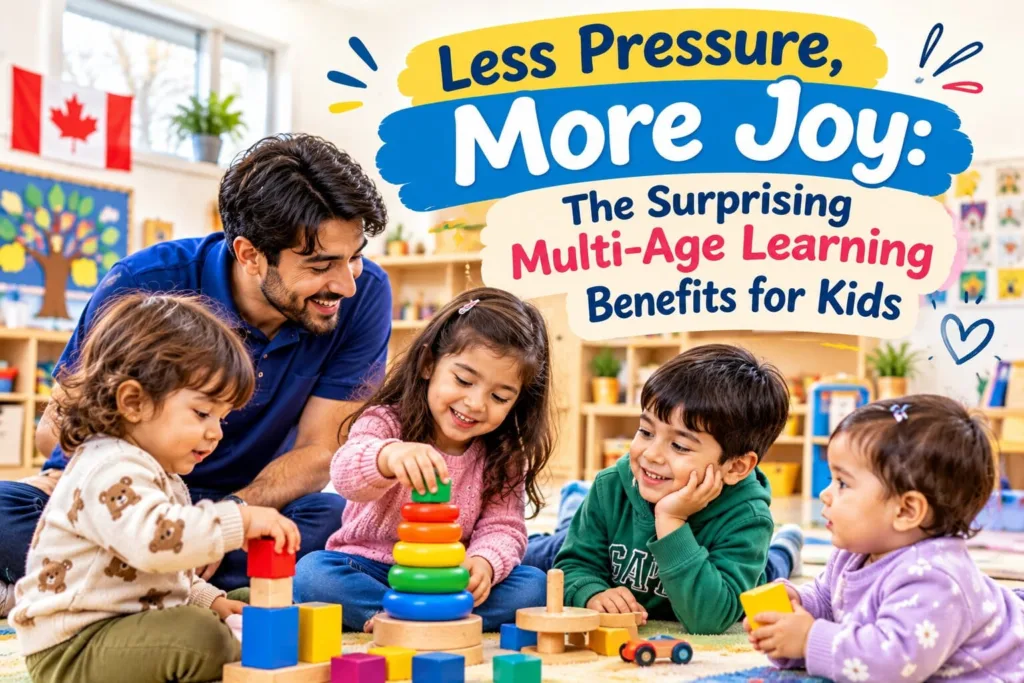
Walking into an early childhood classroom should feel like stepping into a vibrant, supportive neighbourhood rather than an assembly line. For generations, traditional education systems separated children into narrow, single-year age brackets, operating under the assumption that every child born in the same calendar year develops on the exact same schedule. However, modern child psychology and early pedagogy highlight a much more natural, flexible alternative. Discovering the genuine multi-age learning benefits for young children shows how moving beyond strict age silos replaces artificial performance anxiety with authentic, child-led curiosity.
At Surrey City Childcare, located at 12250 100 Ave, Surrey, BC V3V 2X1, Canada, our certified educators integrate the transformative advantages of multi-age learning benefits into daily classroom rhythms. Operating as a reliable, affordable, and professional education provider for toddlers and preschoolers across Surrey and nearby areas, our licensed programs foster a family-style environment where children learn from one another without the pressure of rigid benchmarks.
Curious to see the multi-age learning benefits in action? Connect with our dedicated early learning team at Surrey City Childcare today. Whether you have questions regarding our peer-mentoring curriculum or want to check toddler and preschool space availability, contact us today or visit our centre at 12250 100 Ave, Surrey, BC.
The Architecture of Multi-Age Classrooms: Moving Beyond Rigid Age Silos
In a typical single-age classroom, every child is expected to reach the same milestones at approximately the same time. If a child takes a few extra months to master holding a crayon or expressing frustration through words, they can quickly feel inadequate compared to twenty peers doing the exact same thing. Conversely, children who develop a specific cognitive or motor skill ahead of their peers often find themselves disengaged or under-stimulated.
A multi-age classroom, commonly grouping children aged two-and-a-half to five years, completely dismantles this artificial timeline. Instead of measuring every child against a single developmental yardstick, the classroom environment accommodates a healthy, normal spectrum of abilities.
In this structure, diversity is not an exception; it is the deliberate design. A three-year-old struggling to stack wooden balancing blocks does not look around and see an entire room of children outperforming them. Instead, they see toddlers working on simple grasp-and-drop games alongside older children designing intricate wooden bridges. This broad spectrum normalizes varied abilities, helping children focus entirely on their own progress rather than peer comparison.
Unlocking Natural Peer Modeling in Early Childhood
One of the most powerful mechanisms at work in a mixed-age environment is the social phenomenon of peer observation. While adult educators provide essential safety, emotional grounding, and curriculum planning, toddlers often learn daily habits far more readily from children who are just a step or two ahead of them.
Through intentional peer modeling in early childhood, younger children observe older classmates handling classroom challenges with ease:
- Self-Help Independence: A younger toddler observes a four-year-old calmly unzipping their jacket, hanging it on a low cubby hook, and sliding their indoor shoes on independently. Seeing another child accomplish this sparks a natural desire to imitate that success.
- Emotional Self-Regulation: When an older child encounters a frustration—such as a spilled cup of water—and calmly asks an educator for a cloth to wipe it up, younger onlookers absorb that calm response as the default reaction to everyday mistakes.
- Complex Play Sequences: Younger learners who typically engage in parallel play (playing side-by-side without interaction) watch older peers negotiate complex, cooperative pretend-play scenarios, gradually learning how to enter shared play spaces with confidence.
Because the older child is still a peer, their accomplishments feel immediately achievable to a toddler in a way that adult actions rarely do.
Accelerating Language and Communication Skills Naturally
Language acquisition in early childhood thrives on exposure to rich, responsive conversational exchanges. In a classroom consisting solely of two-year-olds, communication is often restricted to single words, basic gestures, and vocalizations.
When younger toddlers share a space with four- and five-year-olds, their linguistic environment expands dramatically. Older children naturally provide linguistic scaffolding. They speak in complete, descriptive sentences, use varied tone inflections, and narrate their activities out loud during open-ended play:
- “I am building a tall fire station for the rescue trucks. Can you hand me that long blue rectangular block?”
- “Be careful with that water bowl, it might tip over if you bump the table.”
Hearing this continuous stream of practical, contextual language accelerates receptive and expressive vocabulary in younger children. Simultaneously, older children practice expressive clarity. When speaking to a younger peer, an older child must slow down, choose simpler words, and make intentional eye contact, refining their own communication skills and phonological awareness.
Developing Authentic Leadership and Empathy Without Competition
Modern parents often worry that having older children in a mixed-age room might hold them back academically. In reality, pediatric research reveals the exact opposite. Guiding and helping younger peers provides profound cognitive and social dividends for older preschoolers.
To teach a skill or explain a concept to someone else, a child must truly understand it. When an older child helps a younger classmate navigate a wooden puzzle, tie a paint smock, or wash their hands at the sink, several crucial developments occur:
- Consolidation of Knowledge: The older child re-evaluates the steps of the task, reinforcing their own mastery and executive function.
- Prosocial Leadership: The older child experiences the quiet pride of being viewed as a capable, trusted mentor, which bolsters self-worth far more effectively than adult praise.
- Active Empathy: When a younger child cries because they miss a parent during morning drop-off, older peers often step forward with a favourite comfort toy or an invitation to read a picture book. They learn to recognize emotional distress in others and take constructive, caring action.
In this environment, playground turf wars are replaced by natural cooperation. Because older and younger children are not competing for the exact same status or toys, classroom dynamics soften into cooperative community living.
Fostering Healthy Social-Emotional Development in Toddlers
Developing emotional stamina and self-regulation is the primary developmental task of the early years. Supporting positive social emotional development in toddlers requires an environment that minimizes chronic stress while offering regular opportunities to practice social negotiation.
Single-age environments often unintentionally elevate peer friction because all children share the same emotional vulnerabilities at the exact same moment. For instance, twenty two-year-olds who are all navigating the developmental impulse to possess every toy will inevitably experience frequent, intense clashes.
In a mixed-age setting, the varied maturity levels act as an emotional buffer. Older children who have already developed basic impulse control can demonstrate sharing, compromise, and patience. When a younger toddler grabs a toy without asking, a well-supported older peer is far more likely to use their words—“I am using that right now, but you can have it next”—rather than reacting with physical aggression.
Educators actively reinforce these positive interactions, teaching younger children how to wait patiently and older children how to set kind, clear personal boundaries. Over time, toddlers learn that big feelings can be managed through dialogue and gentle compromise.
The Power of Educator Continuity and Long-Term Relationships
In traditional, age-segregated childcare settings, children are moved to a new classroom with entirely new teachers every twelve months. For sensitive young nervous systems, having to break an established emotional attachment and rebuild trust with unfamiliar adults year after year can spark recurring separation anxiety and behavioral regression.
Many licensed multi-age childcare programs offer the gift of relational continuity. A child can often remain with the same primary educators and core peer group across several consecutive years.
This multi-year relationship provides distinct benefits:
- Deep Educator Insight: Educators develop an intimate understanding of each child’s unique learning style, sensory sensitivities, temperament, and family background. No time is wasted at the start of a new school year trying to figure out what motivates the child or triggers their meltdowns.
- Strong Parent Partnerships: Parents build long-term, trust-filled communication channels with their child’s educators, creating a consistent home-to-daycare wellness bridge.
- Emotional Grounding: Toddlers feel completely secure in their physical environment, allowing them to take healthy intellectual and social risks without fear.
Play-Based Foundations and Kindergarten Readiness
A common concern among families preparing for elementary school is whether play-centred, mixed-age environments adequately prepare children for academic success. Parents often ask if their four-year-old will be ready for the structured routines of kindergarten without daily pencil worksheets.
Modern kindergarten curricula across Canada, including British Columbia, prioritize self-regulation, curiosity, executive function, and collaborative communication over rote memorization. A child who enters kindergarten able to recite the alphabet but unable to ask for help, take turns, or regulate their frustration will struggle significantly more than a child who has mastered self-advocacy and social problem-solving.
Embracing play based early learning within a mixed-age environment equips children with these foundational competencies. Through dramatic pretend play, loose-parts engineering, and outdoor physical exploration, children learn to:
- Negotiate shared goals and classroom materials.
- Sustain focused attention on multi-step projects.
- Resolve conflicts constructively using clear verbal communication.
- Adapt to diverse peer personalities and varying physical abilities.
When a child has spent years thriving in an inclusive, collaborative community, stepping into an elementary school classroom feels like a natural, exciting next chapter.
Choosing the Right Early Learning Fit for Your Family in Surrey
Selecting an early learning centre is one of the most significant investments parents make in their child’s early years. Whether you are seeking a community-focused city preschool experience, looking into a supportive mixed-age daycare in surrey, or searching online directories for a qualified licensed toddler daycare surrey provider, understanding a centre’s pedagogical approach to mixed-age grouping is vital.
Families commuting through North Surrey, Guildford, and Whalley often spend substantial time searching for a dependable daycare in surrey bc or entering terms like daycare near me and pre kindergarten near me into map searches. Beyond convenient driving routes and clean facilities, the ultimate value of an early childhood program lies in how safe, respected, and joyful your child feels every single day. When a centre combines small group sizes, experienced certified educators, and a nurturing multi-age philosophy, children receive the balanced support they need to develop at their own pace.
Frequently Asked Questions
How do educators keep younger toddlers safe from choking hazards in a multi-age room?
Licensed multi-age classrooms are intentionally arranged with strict safety zones. Materials featuring smaller pieces intended for older preschoolers—such as small counting beads or intricate interlocking blocks—are stored on elevated tables or in designated activity zones that educators monitor directly. Floor-level toys and shared sensory bins are completely taste-safe and adhere strictly to provincial licensing standards for young children.
What areas in Surrey does your childcare centre serve?
Surrey City Childcare is situated on 100 Avenue, conveniently serving local families living in or commuting through North Surrey, Whalley, Guildford, Fleetwood, City Centre, and surrounding commuter corridors across the Fraser Valley.
What is your team’s typical response time when parents submit an enrollment inquiry?
Our administrative team understands that securing reliable childcare requires prompt communication. We review and respond to all website inquiries, waitlist requests, and scheduled facility tour applications within 24 to 48 business hours on weekdays.
Will my older child be held back if they share a classroom with younger toddlers?
No. In fact, research demonstrates that older children develop superior language skills, executive function, and leadership abilities in mixed-age settings. Certified educators differentiate their curriculum, providing older children with advanced open-ended STEM investigations, complex storytelling projects, and specialized small-group literacy activities tailored to their developmental readiness.
How do nap and rest times work when children have different sleep schedules?
Multi-age classrooms maintain flexible, gentle rest routines. Younger toddlers who require a full midday nap are provided with quiet, darkened resting cots, while older preschoolers who have transitioned out of naps engage in low-energy, quiet table activities—such as reading picture books, drawing, or working with sensory dough—after a brief period of relaxation.
Cultivating Confident, Joyful Learners for Life
Early childhood education should never be a high-stakes race where children are rushed from one rigid benchmark to the next. By embracing the rich, community-centred environment of a mixed-age classroom, we provide young children with the space to grow at their own rhythm, surrounded by peers who inspire, guide, and support them. Experiencing the true multi-age learning benefits helps toddlers build resilient emotional frameworks, robust communication habits, and a genuine love for learning that lasts well beyond their early preschool years.
At Surrey City Childcare, located at 12250 100 Ave, Surrey, BC V3V 2X1, Canada, our passionate early childhood educators are dedicated to providing a safe, affordable, and licensed early learning environment for local families. Through our family-style approach, we ensure that every child—from curious younger toddlers to confident older preschoolers—feels valued, capable, and understood. If you are exploring nurturing early learning environments or wish to see our collaborative community in action, connect with our friendly staff today to book a personal tour of our modern Surrey facility.