
Quick Summary
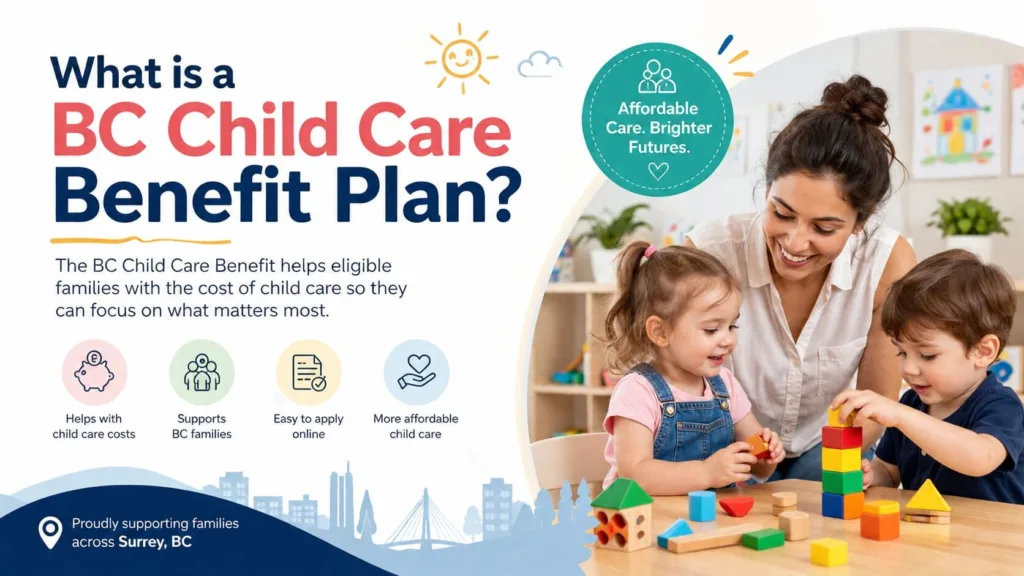
- Comprehensive Financial Aid: The BC Child Care Benefit Plan is an income-tested provincial subsidy program designed to help British Columbia families reduce the overall monthly cost of early childhood services.
- Direct Funding Model: Approved financial assistance from the BC Child Care Benefit Plan is issued directly to participating childcare providers, reducing out-of-pocket parent fees on monthly tuition invoices.
- Layered Affordability: The BC Child Care Benefit Plan can be stacked simultaneously with the universal Child Care Fee Reduction Initiative (CCFRI) to maximize total household savings.
- Strict Care Requirements: To successfully access the BC Child Care Benefit Plan, families must utilize qualifying licensed childcare options and meet established provincial income and care criteria.
Raising young children in the Lower Mainland is a deeply rewarding experience, yet navigating the practical logistics of early childhood education can quickly become overwhelming for modern families. Between managing busy work schedules, tracking developmental milestones, and looking for high-quality care, parents frequently face significant hurdles regarding the financial side of early learning programs. Fortunately, the provincial government offers robust systems to alleviate this financial pressure, most notably through an approved BC Child Care Benefit Plan.
If you are looking for premium, trustworthy, and affordable early childhood options, Surrey City Childcare provides services explicitly designed to align with these provincial support frameworks, ensuring a seamless experience from initial enrollment to classroom adjustment. Located at 12250 100 Ave, Surrey, BC V3V 2X1, Canada, our professional centre acts as a dedicated partner, helping local parents understand their approved provincial funding configurations while maintaining a warm, supportive environment built for their toddlers’ early development.
Demystifying the BC Child Care Benefit Plan
Many parents find the terminology surrounding provincial funding models somewhat confusing. It is common to hear terms like “childcare subsidies BC,” “ACCB,” and “benefit plans” used interchangeably in parenting communities. To clarify, the Affordable Child Care Benefit (ACCB) is the official name of the income-tested provincial funding program itself. When a family applies for this funding and receives formal approval from the Ministry of Education and Child Care, the ministry generates a customized document known as your official benefit plan.
This personalized plan functions as a financial blueprint for your child’s care configuration. It details the exact eligibility dates, the authorized care type, the maximum number of full or half days funded each month, and the precise dollar amount the province will contribute toward your monthly tuition. Rather than sending a monthly cheque to your household, the ministry transfers these funds directly to your approved childcare facility. Your provider then subtracts this subsidy from your gross monthly bill, leaving you responsible only for the remaining balance, often referred to as the parent portion.
Core Eligibility Requirements for British Columbia Families
Securing an approved benefit plan requires meeting a series of strict provincial baseline criteria. The application process evaluates several factors, including your residency status, income thresholds, family structure, and your specific daily need for child supervision.
1. Canadian Status and British Columbia Residency
The primary applicant must be a current resident of British Columbia with a valid residential address. Additionally, the applying parent or legal guardian must be a Canadian citizen, a permanent resident of Canada, a Convention refugee, or a person who has been granted protection status. Temporary residents with valid study or work permits are also eligible to apply, provided they meet all other underlying program guidelines.
2. Verified Qualifying Reasons for Care
The province designed this financial framework to support families who genuinely require childcare to maintain workforce participation, complete education, or manage unique medical situations. To qualify for a plan, both parents (or the single parent in a lone-parent household) must provide a valid reason for care. Eligible reasons include:
- Being employed or running a verified self-employed business.
- Attending an accredited school, university, or vocational training program.
- Participating in an approved provincial employment readiness program.
- Actively looking for employment (applicable to only one parent or guardian at a time).
- Managing a documented medical condition that temporarily interferes with your ability to care for your child.
- Enrolling a child who is at least 30 months old into a licensed preschool program.
3. Selecting Authorized Care Facilities
Your approved funding cannot be applied to any arbitrary care arrangement. The province explicitly excludes non-licensed care provided by a relative who resides in your immediate household. It also excludes occasional drop-in services or short-term recreational camps. To leverage your provincial benefits, you must enroll your child in eligible licensed childcare options, such as licensed group daycare centres, licensed family childcare homes, or registered licence-not-required facilities.
Understanding the Financial Tiers and Funding Calculations
The total amount of financial relief provided by an active plan is determined through an income-tested calculation model. The ministry evaluates your household’s net adjusted annual income, which is pulled directly from your Canada Revenue Agency (CRA) Notice of Assessment.
Generally speaking, families across British Columbia with an adjusted annual household income up to $111,000 may qualify for either partial or full provincial funding. Families with a net income at or below approximately $45,000 per year are typically eligible to receive the maximum available benefit tier for their specific care class. For households earning above $111,000, eligibility is generally capped, though exceptions are frequently made for larger families with multiple dependents or households caring for children who have identified support needs requiring specialized early intervention.
The age of your child and the specific care format play a massive role in the final calculation. For example, group care settings for infants under 19 months face the highest administrative operational costs, meaning the maximum provincial benefit tier for this group can reach up to $1,250 per month per child. As children transition into the 19-to-36-month cohort, and eventually into the 37-month-and-older preschool brackets, the maximum baseline subsidy rates adjust downward to reflect changing provincial staff-to-child ratios.
Furthermore, annual family income variables are systematically adjusted based on family size metrics. The ministry reduces your calculated annual income by $2,000 for each additional family member after the first two individuals. If your household includes a child with support needs, your baseline income metric is reduced by an additional $3,000, and you may qualify for an extra monthly supplement of up to $150 to ensure your child receives proper classroom accommodation.
Stacking Your Benefits: The Layered Affordability Model
One of the greatest advantages for modern parents navigating childcare subsidies BC frameworks is the ability to layer multiple affordability programs simultaneously. The provincial childcare system operates on a multi-tiered public utility approach designed to make high-quality early childhood education accessible to everyone.
The first layer of this model is the universal Child Care Fee Reduction Initiative (CCFRI). Unlike the income-tested benefit plan, the CCFRI is a non-income-tested discount applied directly at the institutional level. If your chosen licensed daycare centre participates in the CCFRI, the facility receives operational funding from the government to lower its base tuition rates automatically. Parents do not need to fill out separate income applications for this tier; the savings are simply deducted from the standard fee schedule.
The second layer is your personalized, income-tested benefit plan. When you are approved for this subsidy, your personal benefit amount is stacked directly on top of the already reduced CCFRI base fee. For many qualifying Lower Mainland families, combining these two separate funding structures reduces out-of-pocket monthly daycare costs from over $1,200 down to a few hundred dollars, or in some scenarios, down to zero.
Step-by-Step Guide to Managing Your Funding Flow
To ensure your provincial benefits remain active and free of administrative interruptions, parents must follow a strict operational timeline. Missing deadline dates or failing to submit accurate verification paperwork can result in temporary plan suspensions, leaving parents temporarily responsible for full gross tuition rates.
- Submit Your Application Early: You must apply for your provincial subsidy before the end of the calendar month in which your child begins attending the centre. If your toddler starts their care program on September 1, your completed application must be formally logged within the system by September 30 to prevent a loss of funding for that initial month.
- Gather Essential Identification: The online My Family Services portal requires clear digital copies of primary government-issued identification for every member of your household. Acceptable documents include Canadian birth certificates, citizenship cards, permanent resident cards, or valid passports.
- Coordinate the Child Care Arrangement Form: Before your application can be officially adjudicated, your chosen licensed provider must complete and sign a specialized document verifying enrollment schedules, care codes, and monthly institutional fees.
- Monitor Your Renewal Windows: Benefit plans are not permanent; they must be fully renewed on an annual basis, or immediately whenever your household experiences a shift in its qualifying reason for care (such as changing jobs or transitioning from school to employment). It is highly recommended to submit your renewal documentation through the online portal at least 30 days prior to your current plan’s expiration date.
Frequently Asked Questions
What happens if my child is absent due to illness or vacation?
The provincial subsidy program requires accurate daily attendance tracking, which includes logging exact arrival and departure times. While the ministry allows for minor, reasonable absences due to temporary childhood illnesses, extended unexcused absences can impact your monthly funding claims. If a child is away from the classroom for a large portion of the month without a valid medical note or prior structural adjustment, the province may prorate the subsidy payout, leaving the parent responsible for covering the funding deficit.
Can I appeal a provincial decision regarding my benefit calculation?
Yes, parents have full legal recourse if they believe their benefit plan calculations are incorrect or based on outdated financial information. If you disagree with an adjudication decision, your first step is to contact the centralized Child Care Service Centre to discuss the data with an official adjudicator. If the discrepancy cannot be resolved informally, you have exactly 20 business days from the date of your formal notification letter to submit an official Request for Reconsideration form detailing your financial adjustments.
Is there local space availability for families using provincial benefits at your Surrey location?
Space availability fluctuates throughout the year based on changing seasonal enrollment patterns and changing age cohorts. Because we strictly adhere to provincial licensing caps to ensure a high-quality educational environment, spaces in our infant and toddler programs fill up quickly. Parents are encouraged to connect with our administrative team early to verify real-time classroom openings and join our structured tracking waitlist.
What is the typical local response time for processing enrollment and subsidy paperwork?
When applications are submitted electronically through the secure My Family Services portal, the provincial government’s standard processing window is approximately ten business days. Locally, our internal administrative team reviews and returns completed Child Care Arrangement Forms within two to three business days, ensuring that families encounter no unnecessary structural delays when filing their paperwork with the ministry.
Do your childcare services cover all major neighborhoods across the Surrey region?
Our professional, licensed care services are centrally located to conveniently accommodate commuting families from all major regional hubs across the city, including Whalley, Newton, Guildford, Fleetwood, and Cloverdale. Our strategic positioning along primary regional transit corridors makes drop-offs and pick-ups simple and efficient for working parents.
Final Thoughts on Affordable Early Learning
Investing in high-quality early childhood education sets a firm foundation for a child’s lifelong cognitive, social, and emotional growth. Understanding the mechanics of the BC Child Care Benefit Plan allows parents to confidently access premium care options without compromising their household’s financial stability. Navigating the regulatory landscape of provincial applications, CRA income verifications, and annual renewals can feel daunting, but you do not have to walk through the paperwork alone.
As a community-focused organization, Surrey City Childcare provides services designed to guide you through every step of the enrollment and funding process. Operating out of our well-equipped facility at 12250 100 Ave, Surrey, BC V3V 2X1, Canada, our professional educators and dedicated family support staff stand ready to help you optimize your child’s early learning path. Reach out to our admissions team today to schedule a personalized tour, review your provincial subsidy options, and secure a nurturing, reliable environment where your child can truly thrive.