
Summary
- Intentional nature exploration in a licensed center daycare transforms ordinary outdoor play into foundational scientific inquiry for young children.
- British Columbia’s natural coastal environment provides dynamic materials for toddlers and preschoolers to investigate biology, weather cycles, and physics firsthand.
- Guided plant study and garden activities teach early botanical concepts, fine motor precision, patience, and environmental respect.
- Integrating open-ended STEM investigations outdoors aligns directly with the provincial BC Early Learning Framework.
- Surrey City Childcare balances academic discovery with nature-based play, providing local families with dependable, enriched early learning routines.
When parents think about early childhood science, they often imagine laboratory coats, test tubes, or formal classroom desks. In reality, the most profound scientific discoveries for toddlers happen outdoors, with dirt under their fingernails and fallen cedar leaves in their palms. Young children are natural researchers; they touch, test, drop, and examine everything in their path to understand how the physical world operates. Choosing an accredited center daycare that embraces outdoor learning ensures that this innate curiosity is guided into meaningful cognitive development.
At Surrey City Childcare, situated at 12250 100 Ave, Surrey, BC V3V 2X1, Canada, our dedicated team serves as a reliable, affordable, and professional education provider for toddlers and provides a specialized Multi-Age Program designed to connect growing minds with the living world around them.
Redefining Early Science: Moving Beyond the Indoor Classroom
Science in early childhood education is rarely about memorizing botanical terms or completing repetitive worksheets. Instead, it is a mindset rooted in observation, prediction, experimentation, and reflection. While indoor play corners offer wonderful construction and dramatic play opportunities, the outdoors presents an ever-changing living laboratory.
A controlled indoor room maintains consistent lighting, static temperatures, and predictable surfaces. Step outside into a secure play yard, and children encounter dynamic variables: shifting shadows, morning dew on clover, worms surfacing after coastal rain, and wind rustling through native Douglas firs. These natural shifts provoke questions that indoor toys simply cannot duplicate.
By integrating scientific thinking into regular daily routines, experienced educators help children view themselves as capable observers of nature. Whether your child is enrolled in an infant and toddler daycare surrey program or preparing for kindergarten, regular outdoor investigation lays the groundwork for structured analytical thinking.
The Pedagogical Framework: Aligning with BC Early Learning Standards
High-quality early learning does not leave outdoor play to chance. In British Columbia, licensed programs shape their outdoor science curriculum around the BC Early Learning Framework. This provincial guide highlights the critical connection between children, their local communities, and the natural landscape.
The framework identifies four core developmental ideals:
- Well-Being and Belonging: Cultivating physical confidence, spatial orientation, and a safe sense of place in the outdoors.
- Engagement with Materials: Interacting with living, organic matter such as loam, river stones, seedpods, and bark.
- Communication and Literacies: Expanding descriptive vocabulary to document textures, moisture, scent, and seasonal shifts.
- Social Responsibility: Developing early environmental stewardship and respect for living plants and organisms.
When educators implement outdoor play based learning, outdoor spaces become intentional extensions of the indoor classroom rather than a simple recess period. Children learn that learning happens everywhere, not just when sitting at a craft table.
From Seeds to Sprouts: Plant Study as an Early STEM Laboratory
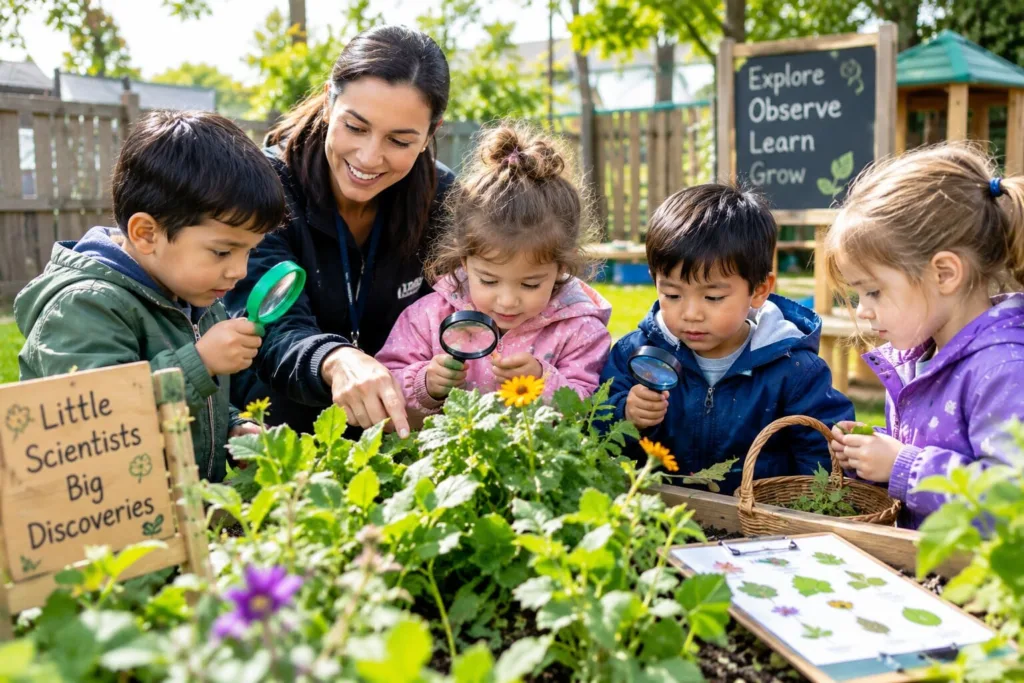
Planting seeds and observing their development is one of the most effective ways to introduce early STEM concepts to young learners. A child-focused garden bed or raised planting box offers a multi-layered curriculum that touches upon biology, mathematics, chemistry, and environmental science.
1. Botany and Life Cycles
Planting a sunflower or bean seed allows toddlers to witness biological transformation in real time. Educators guide children to monitor changes: first a green shoot emerges through the soil, then tiny cotyledon leaves unfurl, followed by sturdy stems reaching toward sunlight. Children learn that plants require soil, water, warmth, and light to flourish. This builds an intuitive understanding of life cycles, habitats, and ecological interdependence.
2. Early Mathematics and Measurement
Gardening provides endless organic math experiences. Children count seeds as they place them into planting troughs, practice spacing them two fingers apart, and use wooden rulers or hand spans to measure weekly sprout height. They compare leaf dimensions, categorize foliage by shape (round, serrated, or needle-like), and pour measured volumes of water using small watering cans. These stem activities for preschoolers make mathematical abstractions tangible and easy to remember.
3. Sensory Exploration and Soil Science
Soil is not simply mud; it is a complex ecosystem. Digging into rich compost introduces toddlers to earthworms, beetles, and microbial decay. Children feel the distinction between gritty sand, moist loam, and sticky clay. Smelling freshly turned earth, feeling cool damp moss, and observing dry crumbling dirt build rich sensory neural pathways that form the foundation for sensory integration and emotional grounding.
Fostering Fine and Gross Motor Skills Through Nature Play
Outdoor exploration is equally essential for physical physical literacy. Fine motor skills, which are vital for future pencil control and handwriting, are often developed more naturally outdoors than with traditional table crafts.
Consider the intricate hand-eye coordination and finger dexterity required during nature exploration:
- Gently plucking a ripe berry without crushing it.
- Peeling dry husks off seedpods using a pincer grasp.
- Scooping soil into narrow pots with hand trowels.
- Sorting tiny smooth pebbles from coarse wood chips.
- Balancing delicate blossoms between thumb and index finger.
Simultaneously, outdoor learning surrey bc environments challenge gross motor balance and proprioceptive systems. Navigating uneven wood chips, stepping across flat balancing stones, hauling small watering pails, and squatting down to examine a low garden bed build core stability, leg strength, and joint awareness. These physical foundations give children the physical stamina required to sit comfortably and maintain focus during formal schooling later on.
Emotional Co-Regulation in Living Environments
The benefits of nature-inspired learning reach far beyond cognitive gains. Child psychology consistently demonstrates that immersion in natural settings lowers cortisol levels, reduces anxiety, and enhances emotional self-regulation in developing toddlers.
In modern society, young children are frequently surrounded by synthetic surfaces, artificial illumination, and digital devices. When toddlers enter an outdoor space filled with plants, birds, and open sky, sensory overload dissipates. The ambient sounds of rustling leaves and splashing water create a calming background that supports emotional balance.
In a mixed-age group setting, working alongside peers in a garden bed fosters collaborative social development. Children take turns holding the watering hose, share small rakes, celebrate the emergence of a new blossom together, and help gently release a ladybug onto a shrub. These shared experiences teach empathy, patience, and peaceful cooperation.
What to Look for When Touring Outdoor Spaces in Daycares
As you research daycares in surrey to find the best fit for your little one, pay close attention to how the facility approaches its outdoor learning environment.
Here are essential features to observe during your visit:
- Dedicated Outdoor Exploration Zones: Does the facility offer natural elements such as raised planter boxes, tactile sensory bins, and digging gardens alongside traditional swings or plastic slides?
- Fraser Health Regulatory Compliance: A professional licensed daycare surrey families rely on must provide at least seven square metres of outdoor space per child, surrounded by secure fencing, with cushioned impact zones beneath all structures.
- All-Weather Outdoor Policies: Does the centre embrace outdoor play throughout the West Coast autumn and winter using waterproof rain suits and boots, or do children remain indoors during light drizzle?
- Educator Engagement: Observe how teachers interact outside. Are they actively down at eye level helping toddlers inspect leaves and ask questions, or are they merely supervising from a distance?
A quality childcare provider views their outdoor yard as a vital learning arena where thoughtful educators nurture early scientific inquiry every day.
Frequently Asked Questions
How do educators keep toddlers safe while exploring outdoor soil and plants?
Licensing regulations require centres to thoroughly vet all garden beds and grounds for toxic plants, sharp objects, or chemical pesticides. Our educators supervise children at close ratios, model gentle handling of all living organisms, and maintain strict handwashing routines immediately after outdoor play to uphold high hygiene standards.
Does outdoor science exploration continue during rainy Surrey winters?
Yes. Rain is a natural feature of our West Coast ecosystem and offers wonderful scientific learning opportunities. Children wear waterproof rain gear and boots to investigate water flow, gutter runoff, puddles, and worm activity. Unless extreme weather warnings or freezing temperatures pose safety concerns, daily outdoor play remains a consistent part of our schedule.
What areas of Surrey do your early learning services cover?
Our centre welcomes families across North and Central Surrey, including Whalley, City Centre, Guildford, Fleetwood, and nearby Newton neighbourhoods. Our convenient location along 100 Ave offers an easy morning drop-off for parents commuting along King George Boulevard, 104 Ave, or Highway 1.
How quickly does your administrative team respond to tour requests and waitlist inquiries?
We recognize that parents returning to work or school need clear enrollment timelines. Our administrative team typically responds to all online inquiries, waitlist submissions, and phone calls within twenty-four to forty-eight business hours to discuss classroom availability and schedule an in-person walkthrough.
Can infants and young toddlers participate in gardening activities?
Yes. For infants and younger toddlers, garden study is adapted to be entirely sensory and tactile. They touch non-toxic broad leaves, explore cool water in outdoor basins, smell fragrant culinary herbs like mint and rosemary, and observe older children planting seeds in a safe, supported setting.
Cultivating Lifelong Curiosity in Surrey Children
Early childhood is a brief window when the simplest natural occurrences—a falling autumn leaf, a burrowing earthworm, or a sprouting sunflower seed—spark genuine wonder. Placing your child in a nurturing environment that values hands-on science nurtures their cognitive potential, emotional calm, and environmental empathy. When intentional outdoor study is woven into daily childcare, toddlers build critical thinking skills that prepare them for kindergarten and beyond.
At Surrey City Childcare, located at 12250 100 Ave, Surrey, BC V3V 2X1, Canada, we provide an enriching early learning environment where children explore the beauty of the natural world. From our responsive infant rooms to our dynamic Multi-Age Program, our certified educators guide young children toward joyful daily discovery. If you are searching for a surrey daycare near me that combines licensed safety with enriching outdoor play, connect with our team today to schedule an in-person tour and see how an intentional center daycare can support your child’s developmental journey.