
Summary
- Understand how a primary developmental framework transforms early childhood exploration into essential academic and social confidence.
- Discover the scientific reality of play-based learning and why it far exceeds basic supervision or static worksheets.
- Learn about the specific cognitive, emotional, and fine motor benchmarks required for a smooth transition into elementary classrooms.
- Explore how a trusted local environment helps children develop self-regulation, language skills, and lasting peer relationships.
The early years of a child’s life fly by in a blur of rapid milestones, muddy handprints, and endless curiosity. For parents living in the Lower Mainland, transitioning a child from the comfort of home routines into the broader world of structured classrooms can feel both exhilarating and deeply intimidating.
A common misconception that still lingers in community conversations is the idea that early childhood settings are merely operational holding environments—essentially a premium babysitting service to keep children safe until formal schooling starts. In reality, the modern early childhood landscape operates on a fundamentally deeper level. Early learning centers provide the foundational architecture for human intelligence, social competence, and emotional resilience. When families look for a reliable, affordable, and professional service provider with a primary developmental approach on Ave, Surrey, BC, they are looking for a true educational partner.
By choosing the specialized framework of primary education in 12250 100 Ave, Surrey, BC V3V 2X1, Canada, you are ensuring that your toddler’s natural curiosity is intentionally channeled into the core competencies needed to thrive in a lifelong educational journey. At Surrey City Childcare, we see this phase as the essential launching pad where playful discovery meets serious developmental preparation.
Deconstructing Play-Based Learning: The Science of Discovery
To understand why a play-based curriculum is so vital for a toddler’s development, we have to look closely at how young brains absorb information. A toddler does not learn efficiently by sitting silently at a desk, memorizing flashcards, or completing repetitive tracing sheets. Force-feeding abstract academic concepts too early often leads to situational anxiety and early academic burnout. Instead, young children are evolutionary designed to learn through hands-on, immersive experimentation. They are, in the truest sense, tiny scientists testing the physical laws of their immediate world.
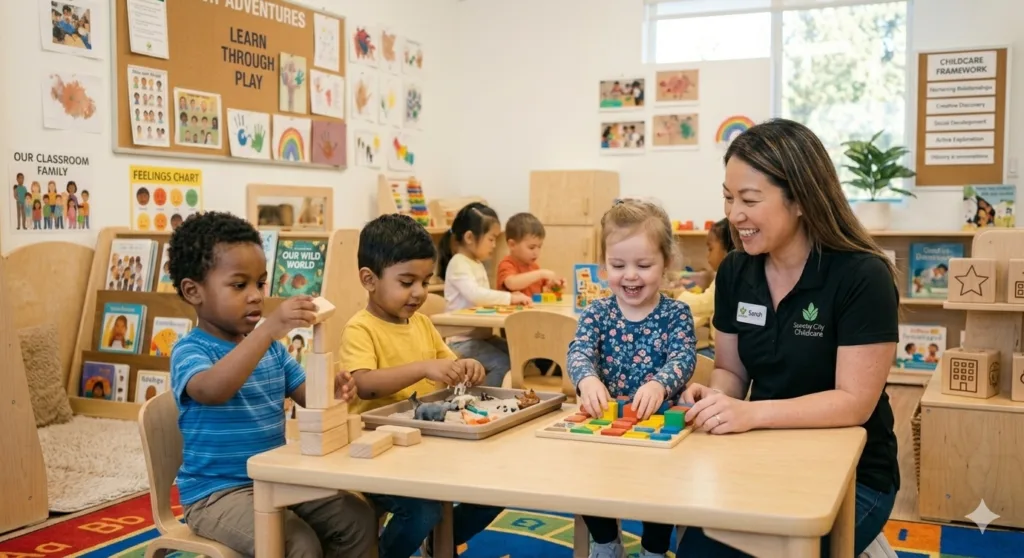
When a child spends time at a classroom sensory table, pouring water through wheels or scooping dry lentils into different-sized containers, they are not simply making a mess. They are actively studying advanced mathematical concepts such as volume, mass, and conservation of matter. When they stack wooden blocks of varying lengths, they are experimenting with gravity, balance, spatial awareness, and structural engineering.
Professional educators utilize these spontaneous moments of play to introduce scaffolded learning. If a group of children is highly fascinated by building a toy train track, the teacher might gently introduce color patterns, counting tasks, or vocabulary words related to mechanics and geography. This intentional approach ensures that cognitive growth remains a joyful, deeply engaging adventure rather than an artificial chore.
The Social-Emotional Architecture: Moving from Autonomy to Collaboration
Ask any kindergarten teacher in the Surrey School District what they look for most on the very first day of school, and they will rarely prioritize a child’s ability to read full sentences. Instead, they will describe a child’s capacity to follow a multi-step routine, share materials with peers, manage personal frustrations, and listen attentively during a group circle. These are the core elements of social-emotional literacy, and they cannot be mastered overnight.
The Dynamics of Group Navigation
Inside a dedicated early learning environment, children transition from parallel play—where they simply play next to each other—to true collaborative play. This shift requires a massive leap in brain development. Toddlers must learn the intricate art of negotiation, perspective-taking, and sharing. When two children want to use the exact same toy truck, a trained early childhood educator does not merely intervene and confiscate the item. Instead, they coach the children through the interaction, giving them the explicit scripts needed to express their desires and respect boundaries. This intentional guidance lays the groundwork for successful peer interactions in future classrooms.
Co-Regulation and Emotional Strength
Developing emotional intelligence also requires learning how to handle big feelings like disappointment, anger, and overstimulation. When a child’s block tower accidentally falls, their immediate response might be to cry or strike out. In an intentional, play-based setting, teachers practice co-regulation. They meet the child at eye level, validate the frustration, and teach simple, physical calming strategies like deep breathing or taking a brief break in a cozy reading corner. Over time, the child internalizes this supportive adult voice, transforming external co-regulation into personal self-regulation. This resilience allows them to face future academic challenges with a calm, focused mindset.
Executive Function: The Brain’s Air Traffic Control System
Executive function is a collective term for the cognitive processes that enable us to plan, focus our attention, remember instructions, prioritize tasks, and successfully manage multiple responsibilities. Scientists often compare executive function to the air traffic control system of a busy airport—it safely manages the arrivals and departures of thoughts and impulses across the brain’s networks.
Establishing Rhythmic Predictability
A high-quality educational environment fosters executive function by establishing a predictable, rhythmic flow throughout the day. While the schedule remains flexible enough to accommodate spontaneous learning moments, the general sequence of events—moving from morning arrival to independent play, group clean-up, snack time, outdoor exploration, and quiet reflection—provides an essential framework of safety. When a toddler can accurately anticipate what comes next in their day, their underlying anxiety drops significantly. They no longer use mental energy wondering what will happen next, allowing them to focus entirely on deep exploration and creative problem-solving.
The Art of the Classroom Transition
Moving from a high-energy outdoor playground to a calm, focused indoor circle time is a highly complex neurological transition for a four-year-old. Early years programs place an immense emphasis on mastering these daily turning points. By utilizing visual schedules, specific musical cues, and clear behavioral benchmarks, children learn how to consciously adjust their internal energy states. This capacity to transition smoothly between different types of focus is an indispensable skill that will serve them perfectly when they enter a larger elementary school setting.
Language Development and Emergent Literacy
Language is the definitive vehicle for all future educational achievement. A child’s vocabulary at age five is an exceptionally accurate predictor of their reading comprehension levels in middle school. However, building a robust linguistic foundation requires an environment saturated in meaningful, reciprocal conversation.
Through shared storytelling, interactive songs, rhyming games, and dramatic role-play, educators continuously expand a child’s phonemic awareness and expressive language skills. Instead of using simple, transactional directives, professional teachers engage toddlers with open-ended questions that require critical thought and descriptive explanation. For example, rather than asking, “Is that a blue car?” an educator might ask, “How do you think we could build a bridge that is strong enough to hold that heavy car?” This intentional vocabulary expansion physically alters the neural architecture of the developing brain, priming it for the reading and writing requirements of the primary grades.
Fine and Gross Motor Mastery
Physical literacy is another crucial element that a play-based curriculum addresses with absolute intentionality. A child’s physical competence directly impacts their social confidence and their ability to engage with classroom learning materials.
Fine Motor Strength for Early Writing
Before a child can comfortably hold a pencil, trace letters, or use safety scissors in a kindergarten classroom, they must develop the intrinsic muscles of their hands and fingers. A play-based environment provides endless opportunities to build this fine motor control. Working with clay, pinching small items with tweezers, threading beads, tearing paper for collage art, and manipulating sensory materials are all deliberate exercises disguised as fun activities. This hand strength and finger dexterity are absolute prerequisites for formal handwriting instruction.
Gross Motor Confidence and Well-Being
Gross motor development involves the coordination of large muscle groups responsible for balance, running, jumping, and climbing. Access to secure, dynamic outdoor play spaces allows toddlers to challenge their physical limits safely. Navigating logs, climbing play structures, and participating in group games build spatial awareness, core physical strength, and cardiovascular health. A child who feels strong, nimble, and physically capable on the school playground is far more likely to engage confidently with their peers during recess, reducing instances of playground isolation.
Choosing the Ideal Educational Foundation in Surrey
As you navigate the wide variety of childcare options in the Lower Mainland, remember that your choice should align with your family’s values and your child’s unique personality. Early childhood education is a deeply personal journey, and finding the right local space requires a careful look at how a facility operates daily.
For families investigating premium options or searching for the best primary schools near me to secure a smooth educational continuum, Surrey City Childcare provides early learning programs built on absolute trust, certified ECE expertise, and responsive care. Our beautiful facility on Ave, Surrey, BC, is fully designed to serve as a nurturing extension of your home, ensuring your child receives the specialized, balanced preparation they need to thrive in the primary grades and beyond.
Frequently Asked Questions (FAQs)
How does play-based learning prepare my child for academic math and reading?
Play-based learning introduces abstract academic concepts through concrete, real-world experiences. When children sort toys by shape, count blocks, or listen to rich storytelling, they are building the exact mathematical logic and phonemic awareness required for formal reading and math. This ensures their cognitive foundation is robust, intuitive, and completely free from early academic stress.
What qualifications do the educators at Surrey City Childcare hold?
Our passionate team consists of fully certified Early Childhood Educators (ECEs) who have completed dedicated post-secondary training in child psychology, pedagogy, and development. Every staff member undergoes strict provincial background screening, maintains valid Child Care First Aid/CPR certifications, and participates in ongoing professional development to bring the best early learning practices to our classrooms.
How do you handle the transition for a child who has never been in daycare before?
We view the settling-in process as a gentle, collaborative partnership between our staff and your family. We encourage a gradual entry schedule, where stay times are slowly increased over the first week. Our educators utilize personalized comfort strategies and emotional co-regulation to help your child feel entirely safe, secure, and excited to explore their new environment.
What geographical areas do your early learning programs serve?
Our licensed center is centrally located in North Surrey, making it highly accessible for commuting families across the city. We proudly welcome children from Whalley, Guildford, Fleetwood, and nearby surrounding Lower Mainland communities who are seeking an exceptional educational start.
Conclusion / Final Thoughts
The transition into elementary school does not have to be a source of stress or anxiety for your household. When a toddler is immersed in a high-quality early years environment that prioritizes emotional security, executive function, and purposeful inquiry, they don’t just learn—they flourish.
Securing a premium educational foundation requires a thoughtful balance of professional expertise and genuine, heartwarming care. It is about choosing a community where your child’s natural curiosity is honored and carefully developed every single day.
At Surrey City Childcare, we are deeply privileged to serve as that reliable, affordable, and professional partner for local families. Our dedicated focus on a play-based curriculum ensures that your child is completely prepared for the academic and social realities of primary education in 12250 100 Ave, Surrey, BC V3V 2X1, Canada. By transforming early curiosity into lasting confidence, we prepare your young learner to make a joyful, completely successful leap into their future junior kindergarten classrooms and a lifetime of discovery.