
Summary
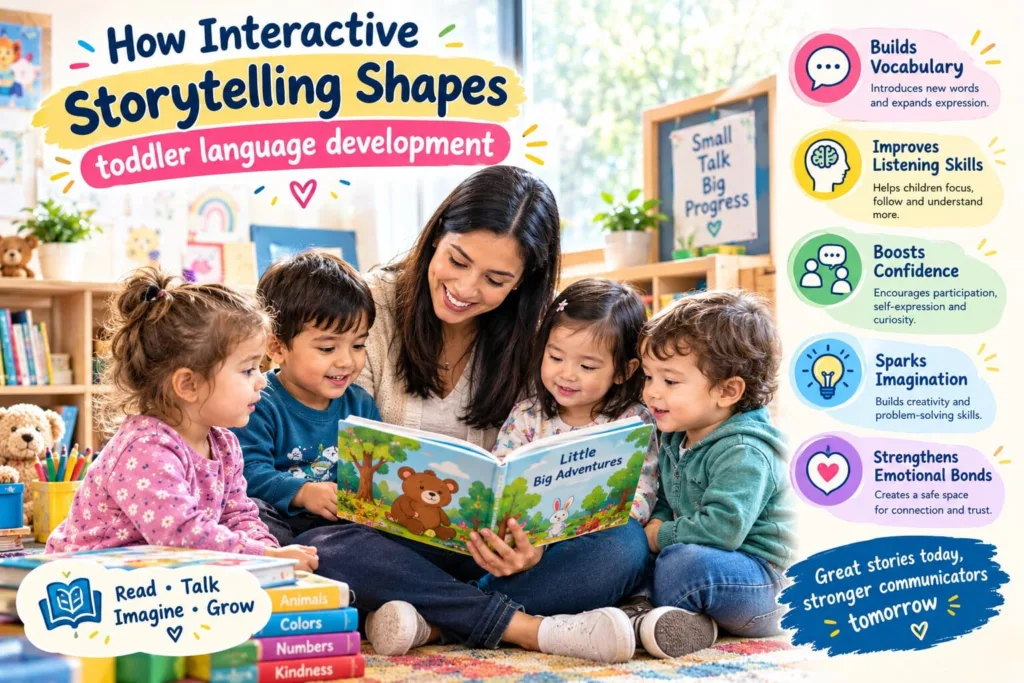
- Interactive storytelling turns passive listening into dynamic conversation, significantly accelerating overall toddler language development.
- Dialogic reading techniques strengthen both receptive understanding and expressive spoken vocabulary through serve-and-return communication.
- Regular shared storytelling supports key early childhood speech milestones by introducing diverse sentence structures and phonemic rhythms.
- Hands-on sensory prompts, puppets, and expressive open-ended questions build early literacy confidence naturally before formal schooling begins.
- Discover how Surrey City Childcare integrates purposeful language baths and story exploration into everyday classroom routines for local families.
When parents settle into an armchair with a picture book at bedtime, they often imagine reading as a quiet, one-way street where an adult speaks while a child listens silently. In modern early childhood education, however, literacy researchers recognize that real linguistic breakthroughs occur when reading transforms into a lively, two-way conversation. Exploring the rich world of interactive storytelling offers a remarkably effective avenue to nurture healthy toddler language development, equipping young minds with the vocabulary, comprehension, and emotional expression they need to make sense of the world around them.
Operating as a reliable, affordable, and professional education provider for toddlers that delivers an exceptional Infant & Toddler Care Program in 12250 100 Ave, Surrey, BC V3V 2X1, Canada and nearby areas, Surrey City Childcare weaves intentional language strategies into every part of the day, helping young learners across our community discover the joy of confident self-expression.
Building strong expressive and receptive speech during early years forms the core foundation for kindergarten readiness in Surrey. Help your child find their voice in a language-rich classroom—Get a Free Quote Now to discover our nurturing toddler programs at Surrey City Childcare!

Understanding the Mechanics of Early Speech and Communication
During the foundational years between twelve and thirty-six months, a child’s neurological pathways for speech expand at an unprecedented rate. Young minds are not simply memorizing sounds; they are mapping the complex social architecture of human dialogue.
Communication development is divided into two primary operational areas:
- Receptive Language: The capacity to comprehend, process, and absorb words, gestures, and questions directed by others. Long before a toddler speaks in complete sentences, their receptive database is storing hundreds of terms, tonal inflections, and contextual cues.
- Expressive Language: The ability to produce sounds, form distinct words, combine phrases, and use body language to convey thoughts, desires, and emotional needs.
When storytime is strictly passive, it primarily exercises receptive listening. While hearing words spoken aloud has immense value, interactive reading bridges the gap between receptive and expressive language. By asking children to pause, point, predict, and narrate, educators and parents invite young learners to actively exercise their expressive speech muscles.
What Makes Storytelling “Interactive”? The Power of Dialogic Reading
Interactive storytelling, often referred to by childhood development specialists as dialogic reading, shifts the child from an audience member into a co-teller of the tale. The adult becomes an active listener, questioner, and guide rather than an uninterrupted performer.
Instead of turning each page automatically as soon as the printed text is finished, the reader intentionally pauses to explore the illustrations and emotional themes.
Consider the difference in approach:
- In a traditional reading setup, an adult reads: “The little brown bear put on his yellow boots to go outside.” The page turns immediately.
- In an interactive storytelling setup, the adult pauses and observes: “Look at those bright yellow boots. Why do you think bear needs boots today? What does the sky look like outside his window?”
This simple pause invites the toddler to examine visual clues, retrieve known vocabulary about weather and rain, formulate an idea, and articulate it out loud. If the toddler answers with a single word like “Puddles!”, the adult expands the phrase: “Yes, muddy rain puddles! He wants to splash with his big boots.” This natural scaffolding loop validates the toddler’s input while modeling expanded grammar and richer vocabulary in real time.
Tracking Early Childhood Speech Milestones Through Books
Children develop along unique individual timelines, yet consistent engagement with books provides a steady benchmark for observing early childhood speech milestones:
12 to 18 Months: Sound Exploration and Object Naming
At this stage, toddlers typically babble with intentional inflection, imitate environmental sounds, and begin mastering single functional words. Interactive reading at this stage relies heavily on point-and-name games. Touching a picture of a tractor and saying “Vroom goes the tractor! Can you show me the big wheels?” encourages pointing, imitation, and joint attention—a vital foundation for social communication.
18 to 24 Months: Vocabulary Explosions and Word Coupling
Around their second birthday, many toddlers experience a rapid surge in vocabulary, commonly known as the naming explosion. They begin stringing two words together, such as “More milk” or “Big dog.” Interactive storytelling during this window provides the ideal playground for two-word combinations. Asking “What is the puppy doing?” prompts the child to combine action verbs and nouns: “Dog running!”
24 to 36 Months: Complex Sentences and Narrative Understanding
By age three, children begin asking relentless questions, using short three- to four-word sentences, and following multi-step storylines. Interactive storytelling shifts toward emotional motivation and sequence: “What happened first?” or “How do you think the kitten felt when she got lost?” This stage nurtures empathy alongside sentence length, helping toddlers label complex emotional states that might otherwise trigger behavioral frustration.
Practical Techniques for Interactive Reading for Toddlers
You do not need specialized theatrical training or expensive sensory tools to make storytime deeply engaging. Simple, deliberate adjustments to your daily routine create an enriching literary atmosphere:
1. Practice the CROWD Prompting Method
Early literacy specialists often rely on the CROWD framework to spark natural dialogue during shared reading:
- Completion Prompts: Leave a blank at the end of a familiar rhyming line for your toddler to fill in, such as “Brown bear, brown bear, what do you…?”
- Recall Prompts: Ask about events that happened a few pages earlier to build working memory: “Did the duck find his mother yet?”
- Open-Ended Prompts: Invite descriptive speech: “Tell me what is happening on this busy street.”
- Wh- Prompts: Ask what, where, when, and why questions to introduce varied interrogative patterns.
- Distancing Prompts: Connect the book’s storyline to the child’s real-world life: “The bunny is eating carrots. Remember when we picked crunchy carrots at the market?”
2. Introduce Multisensory and Physical Props
Toddlers learn through tactile immersion. Pairing a story with soft puppets, felt boards, wooden figures, or natural objects found outdoors turns reading into a hands-on experience. When children hold a small wooden squirrel while listening to a forest tale, the abstract story becomes tangible, locking the associated vocabulary firmly into their memory.
3. Emphasize Rhythm, Repetition, and Phonemic Awareness
Books that celebrate rhythmic meter, playful alliteration, and rhyming patterns tune your toddler’s ear to the distinct sounds inside words. Singing rhymes and exaggerating silly syllables builds early phonological awareness, which serves as a primary predictor of future reading readiness when children enter an elementary school classroom.
The Classroom Advantage: Early Literacy in Group Childcare
While one-on-one reading at home offers cherished parent-child bonding, the group dynamics within a high-quality toddler daycare in Surrey BC bring distinct benefits that home reading alone cannot match.
In a carefully structured group setting, interactive storytelling becomes a shared social event:
- Peer Modeling: When younger toddlers watch slightly older peers ask questions, laugh at punchlines, and raise their hands during a story, they naturally imitate that behavior, accelerating their own expressive attempts.
- Turn-Taking and Collective Focus: Group storytime teaches children how to wait patiently for their turn to speak, listen to friends describe an illustration, and share communal joy over an exciting plot twist.
- Continuous Language Baths: In an accredited infant and toddler daycare surrey setting, certified Early Childhood Educators keep children surrounded by continuous descriptive conversation. Routine moments like peeling oranges at snack, organizing shoes, or washing hands are treated as opportunities for rich narrative narration.
High-caliber early literacy activities do not feel like formal school lessons. Instead, they unfold organically as playful, joyful explorations that leave toddlers eager to pick up books independently during quiet free play.
Selecting the Right Early Learning Environment in Surrey
For parents reviewing local options, finding an educational team that understands the nuanced connection between language acquisition and emotional security is paramount. A comprehensive preschool program should never treat books as convenient distractions to keep children seated quietly. Instead, stories should serve as the vibrant launchpad for classroom discussions, artistic projects, sensory bins, and outdoor inquiries.
When touring licensed childcare in Surrey, observe the classroom library. Are books placed on low, front-facing shelves where toddlers can reach them independently? Are the pages showing signs of loving use rather than being kept pristine behind glass? Most importantly, listen to how the educators converse with the children. Do they listen patiently without rushing to finish the child’s sentences? Do they get down on the floor to meet toddlers at eye level during group circles?
Centres that prioritize responsive conversational turns build children who feel respected, heard, and confident in their own developing voices.
Frequently Asked Questions
How many minutes should an interactive storytelling session last for a two-year-old?
For toddlers between two and three years old, attention spans naturally vary between five and fifteen minutes. Rather than forcing a toddler to sit through an entire book in one rigid sitting, follow their lead. Exploring two pages deeply through interactive conversation, questions, and giggles is far more beneficial for speech development than rushing through an entire book while the child is restless.
What should I do if my toddler only wants to read the exact same book every day?
Embrace the repetition. While reading the same story repeatedly can feel monotonous for adults, it provides immense cognitive comfort to toddlers. Familiarity gives children the confidence to predict what happens next, memorize narrative phrasing, and begin speaking lines along with you. Once they have fully mastered the book, you can begin asking deeper, abstract questions about the characters and background details.
What areas does Surrey City Childcare serve for its early childhood programs?
Our licensed childcare facility is centrally located along 100 Avenue, offering convenient access for families residing and commuting through North Surrey, Central City, Whalley, Guildford, Fleetwood, and surrounding Fraser Valley communities. Our location provides easy drop-off and pickup routes for working parents using transit or commuting along King George Boulevard.
What is your team’s response time for parent inquiries and enrollment questions?
Our administrative team understands that securing reliable, licensed early childcare is an urgent matter for families. We review and respond to all website registration inquiries, tour requests, and telephone messages within twenty-four to forty-eight business hours to answer questions and schedule personal facility visits.
My toddler speaks rarely during book reading. Is this a sign of speech delay?
Not necessarily. Toddlers absorb language internally long before they choose to produce spoken words. If your child is pointing enthusiastically, reacting to funny voices, following multi-step directions, and showing strong receptive comprehension, they are likely building their inner linguistic bank. However, if your child shows persistent difficulties understanding simple requests or reaching expected communication milestones, discuss your observations with your family doctor and your early childhood educators.
Nurturing a Confident Voice for the Future
Language is the fundamental bridge that connects a child’s inner world to their family, peers, and broader community. When parents and educators commit to interactive storytelling, they offer toddlers far more than basic phonics instruction; they give them the tools to articulate needs, build friendships, navigate big feelings, and explore imaginative ideas. Every thoughtful question asked, every silly animal sound imitated, and every shared laugh over an illustrated page contributes directly to a child’s expanding cognitive resilience.
At Surrey City Childcare, located at 12250 100 Ave, Surrey, BC V3V 2X1, Canada, our passionate, licensed educators cultivate vibrant language environments through our dedicated Infant & Toddler Care Program. We take immense pride in supporting local families through every developmental leap, creating joyful, print-rich classrooms where every child’s voice is celebrated. If you are looking for an exceptional preschool near me that nurtures communication, curiosity, and social confidence from the earliest years, reach out to our team today to arrange a personal tour and learn more about our balanced approach to toddler language development.