
Quick Summary
- Understanding the Framework: The British Columbia Early Learning Framework shifts the focus of early education from rigid worksheets to collaborative, inquiry-based discovery.
- Decoding the Four Living Inquiries: A high-quality city of surrey preschool uses daily routines to naturally explore well-being, material engagement, literacies, and social responsibility.
- Bridging to Kindergarten: Play-based environments seamlessly build the fine-motor dexterity, focus, and social autonomy required by local elementary schools.
- Streamlining Local Options: Navigating localized enrollment frameworks helps families choose dedicated, full-day childcare environments over restrictive municipal community centre hours.
Enrolling your child in an early learning program is an incredibly exciting phase of local family life. For parents touring classrooms throughout the Lower Mainland, the initial focus often lands on concrete, visible elements, such as the organization of reading corners, the safety of outdoor play structures, and the overall warmth of the educators. However, the most profound indicator of a premium early years environment lies in its underlying pedagogical philosophy.
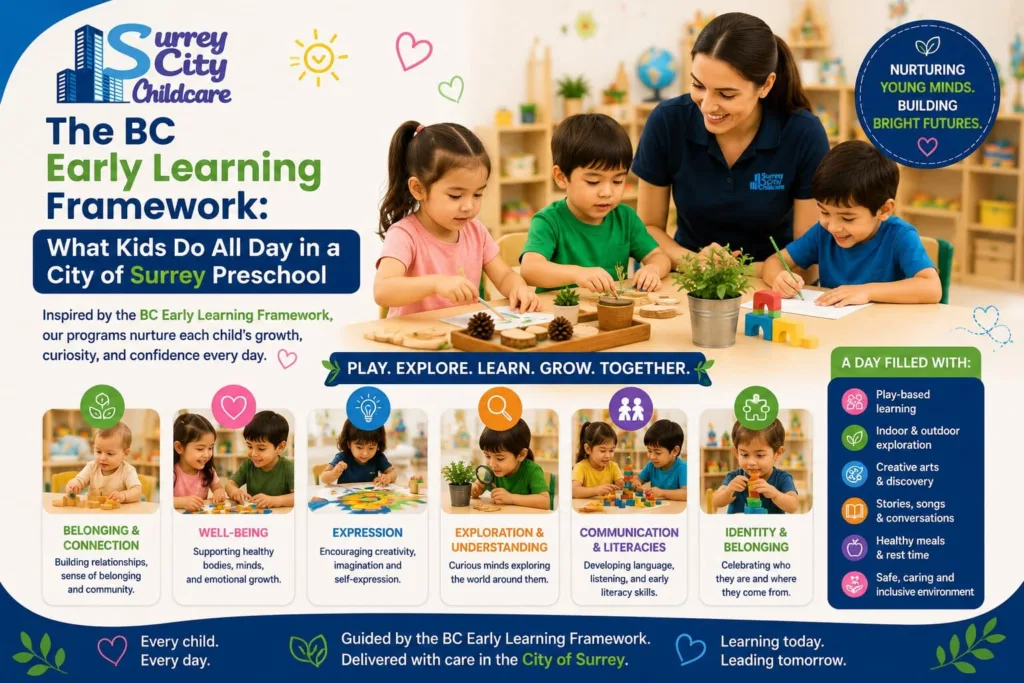
In British Columbia, the gold standard for early childhood education is defined by a comprehensive provincial guide called the BC Early Learning Framework. This framework completely redefines the concept of early schooling, shifting the classroom focus away from passive, repetitive tasks and toward deep, inquiry-based exploration. When families begin researching a premier city of surrey preschool space, understanding how this framework operates in practice gives them the exact tools needed to distinguish exceptional programs from basic supervision.
As a trusted, professional, and family-focused local care provider, Surrey City Childcare provides services explicitly engineered to breathe life into this provincial mandate every single day. Operating from our modern learning facility at 12250 100 Ave, Surrey, BC V3V 2X1, Canada, our certified early childhood educators treat this progressive framework as a living, breathing blueprint to nurture the unique potential of every child in our care.
The Evolution of Early Years Pedagogy in British Columbia
Historically, early childhood environments were frequently divided into two narrow categories: informal daycares focused purely on basic supervision, or rigid preschools that pushed premature academic worksheets. The modern BC Early Learning Framework completely dismantles this outdated division. Developed by the Ministry of Education in close collaboration with early childhood academics, Indigenous organizations, and community Elders, the framework views young children as profoundly capable, curious, and full of individual potential.
The framework spans from infancy all the way up to age eight, intentionally connecting the learning that happens in a daycare in surrey bc with the core competencies taught in public kindergarten to Grade 3 classrooms. When you walk into a classroom that embraces this philosophy, you will not see children sitting in silent rows filling out flashcards.
Instead, you will enter a vibrant, active learning laboratory where literacy, mathematical concepts, and scientific inquiry are woven seamlessly into hands-on exploration. This methodology acknowledges that young minds learn best when they are allowed to manipulate physical objects, experiment with cause and effect, and co-construct knowledge alongside responsive peers and educators.
Deconstructing the Four Living Inquiries: The Daily Preschool Routine
Rather than dividing the school day into isolated subjects like math or science, the provincial framework organizes learning into four deeply interconnected thematic areas known as “living inquiries”. These inquiries describe the complex thinking, doing, and interacting that occurs when children engage naturally with their environment.
1. Well-being and Belonging
A child cannot engage in deep cognitive learning if their emotional security is compromised. This inquiry focuses entirely on helping children establish a safe, comfortable base outside the family home. In a certified preschool south surrey program, this takes the form of predictable morning welcome rituals, dedicated individual cubbies labeled with the child’s own name, and consistent daily rhythms that allow toddlers to anticipate what comes next. Educators actively practice co-regulation, validating a child’s big feelings and helping them build physical autonomy through handwashing, managing clothing, and recognizing their body’s unique signals for rest and nourishment.
2. Engagement with Others, Materials, and the World
This inquiry celebrates the natural wonder children experience when interacting with physical objects and the natural landscape. Instead of purchasing single-use plastic toys, a high-quality center stocks its shelves with “loose parts”—open-ended materials like wooden blocks, pinecones, fabric scraps, and smooth stones. When a group of toddlers stacks various sizes of tree bark to build a vertical tower, they are not just playing; they are actively testing theories of gravity, structural balance, and spatial relations. Furthermore, taking this inquiry out into local parks allows children to observe the changing seasons, explore diverse textures, and build a foundational sense of local environmental stewardship.
3. Communication and Literacies
Early literacy is much more expansive than simply memorizing the alphabet. Under the framework, literacies embrace all the unique ways a young child expresses ideas, communicates thoughts, and interprets symbols. A typical afternoon loop includes vibrant storytelling sessions, learning sign language cues, exploring rhythms through acoustic musical instruments, and documenting thoughts through open-ended painting or clay sculpting. When an educator scribes a child’s spoken description directly underneath their drawing, it teaches the child that their spoken words carry immense value and can be translated directly into written language.
4. Identities, Social Responsibility, and Diversity
Preschool serves as a miniature social laboratory where children learn what it means to be part of a diverse community. Classrooms are designed to reflect the rich cultural fabric of the Lower Mainland, celebrating the diverse traditions, family dynamics, and languages of all participants. Through structured group tasks and daily collaboration, toddlers discover how to share resources, negotiate complex roles during pretend play, practice active turn-taking, and develop genuine empathy when a peer experiences sadness or frustration.
The Role of Pedagogical Narration: Making Learning Visible
One of the most innovative components introduced by the provincial framework is the practice of pedagogical narration. In traditional childcare settings, communication with parents is often limited to basic updates regarding nap times and food consumption. In contrast, an expert educator trained in the framework actively notices, records, and analyzes meaningful moments of child exploration.
This documentation process involves taking photographs of a collaborative building project, recording dialogue during a science experiment, or preserving a sequence of paintings. The educator then compiles these observations into a public narrative display, sharing them with children, colleagues, and families. This practice serves several vital functions:
- It makes the complex inner thinking and problem-solving strategies of the child completely visible to parents.
- It allows the children themselves to look back on their past work, reflect on their ideas, and expand their theories over time.
- It ensures that pedagogical choices made by the staff are deeply intentional, rooted in the evolving interests of the children rather than a pre-packaged, generic curriculum guide.
Balancing the Local Landscape: Navigating Surrey Preschool Systems
As families across the region evaluate early years options, they frequently encounter two distinct structural frameworks: municipal community programs and dedicated group childcare operations. Navigating the specific processes for city of surrey preschool registration requires a clear understanding of these differing models.
Many municipal programs run directly out of regional recreation centers are designed around part-time schedules, offering short 2.5-hour morning or afternoon slots (such as Tuesday and Thursday classes). While these public options are excellent for socializing, their limited operational hours often create significant scheduling gaps for working parents who require a full-day care solution to balance their professional commutes.
To bridge this operational gap, many families choose full-time professional daycares that integrate the exact same provincial early learning curriculum into a sustainable all-day care schedule. This comprehensive approach eliminates the logistical stress of mid-day drop-offs while maintaining the rigorous health, safety, and staffing qualifications mandated by the local health authority.
Prioritizing Budget and Proximity Across the Region
Selecting an early learning environment requires balancing educational philosophy with absolute real-world convenience and family budget parameters.
When researching affordable daycares in surrey, families should evaluate if a center actively participates in the provincial Child Care Fee Reduction Initiative (CCFRI) and accepts the income-tested Affordable Child Care Benefit (ACCB). These government-funded programs layer together to significantly reduce out-of-pocket monthly tuition costs for eligible families, ensuring that premium, licensed early care remains fully accessible to the broader community.
Proximity is equally critical for keeping family stress low. If you live or commute along primary traffic corridors, typing preschool near me or looking into options like a preschool south surrey center can drastically cut down on stressful cross-town transit times. Finding a community-centered hub that offers flexible drop-off windows allows for a peaceful, unhurried morning routine, ensuring your child arrives in their classroom feeling calm, secure, and ready to learn.
Frequently Asked Questions
What is the primary difference between a play-based curriculum and traditional school worksheets?
A play-based curriculum uses a child’s natural curiosity to teach advanced academic concepts through physical engagement. For example, instead of tracing numbers on a piece of paper, a child counts real seashells at a sand table, discovering concepts of weight, measurement, and volume through direct interaction. This approach builds long-term critical thinking rather than simple short-term memorization.
How does the provincial early learning framework connect with the public school system?
The BC Early Learning Framework is explicitly designed to connect with the primary K–3 public school curriculum. By focusing on essential core competencies—such as communication, critical thinking, and social responsibility—preschool children develop the identical foundational habits needed to succeed when entering local elementary schools.
What is your typical response time for families inquiring about enrollment or registration?
Our administrative office reviews and processes all local space inquiries, waitlist applications, and scheduling questions within one to two business days. We prioritize clear, open communication to help families manage their childcare planning and return-to-work timelines with absolute confidence.
What specific geographic areas do your early learning services cover?
Our centrally located facility is perfectly positioned to serve families from across the entire surrounding region, including Whalley, Guildford, Fleetwood, Newton, and North Surrey. Our convenient location makes our center an ideal destination for parents seeking reliable, high-quality care close to their daily commuting routes.
How do educators use pedagogical narration to guide their daily lesson planning?
Instead of forcing children to follow a rigid, pre-planned calendar, educators carefully observe the active interests of the classroom group. If a simple outdoor walk sparks an intense curiosity about birds, the teacher will use pedagogical narration to document that interest, expanding the classroom library, art projects, and science experiments around biology to follow the children’s natural lead.
Securing a Successful Educational Starting Point
Selecting the right early learning environment means choosing a dedicated community that recognizes your child as a capable, creative explorer. By selecting a program that implements the BC Early Learning Framework, you ensure your child’s daily routine is filled with purposeful interactions that naturally foster emotional resilience, social empathy, and intellectual curiosity. Navigating waitlists, registration deadlines, and regional funding options can feel complex, but finding a professional partner makes the entire journey smooth and reassuring.
As a reliable, customer-focused, and accredited local center, Surrey City Childcare provides services built on a foundation of absolute educational transparency and nurturing care. Situated at our accessible community campus at 12250 100 Ave, Surrey, BC V3V 2X1, Canada, our certified early childhood educators treat health, safety, and curriculum excellence as our absolute priorities. Reach out to our admissions team today to schedule an interactive tour, review our active pedagogical portfolios, and secure a premium, licensed space in a city of surrey preschool program where your child can truly shine.