
Summary
- Deciphering Early Learning Curricula: Understanding the pedagogical models used across preschools in south surrey bc helps families choose a program aligned with their child’s unique developmental needs.
- The Power of Inquiry-Based Learning: Modern early education focuses on hands-on exploration, using intentional play to build literacy, numeracy, and scientific thinking.
- Building Executive Functioning: High-quality routines prioritize self-regulation, emotional resilience, fine motor dexterity, and peer collaboration alongside academics.
- Preparing for the Elementary Transition: Aligning daily classroom discovery with the British Columbia Early Learning Framework ensures a confident transition to Kindergarten.
- Evaluating Scheduling & Accessibility: Exploring fee structures, provincial subsidies, and neighborhood accessibility allows parents to secure quality care within budget.
Selecting an early learning environment for your child is one of the most significant choices you will make during their formative years. When families begin searching for preschools in south surrey bc, they encounter a wide array of educational philosophies—ranging from structured academic settings to open-ended play spaces. Understanding what actually happens inside the classroom throughout the day is the key to making an informed decision. Rather than relying on rigid worksheets or passive memorization, quality programs focus on holistic development through social, emotional, cognitive, and physical inquiry.
As a trusted, family-focused local early learning partner, Surrey City Childcare provides services engineered to meet the highest educational and developmental standards. Centrally situated at 12250 100 Ave, Surrey, BC V3V 2X1, Canada, our modern facility offers flexible, play-based learning environments that prepare young children across South Surrey and the surrounding regional communities for long-term educational success.
The Foundation: The British Columbia Early Learning Framework
To understand what is taught in a local classroom, parents must first look at the guiding principles behind early childhood education in British Columbia. Across the province, licensed early learning centers shape their daily routines around the British Columbia Early Learning Framework. This comprehensive framework views children as naturally capable, curious, and full of potential, rejecting outdated models that treat young minds as passive vessels.
Instead of dividing the day into rigid academic periods, the curriculum approaches learning through interconnected spheres of development:
- Physical Health & Well-being
- Emotional Resilience & Self-Regulation
- Social Responsibility & Belonging
- Communication & Expressive Literacies
- Critical & Creative Inquiry
When educators design learning spaces—whether featuring building blocks, dramatic play sets, sensory tables, or art materials—every activity is intentionally crafted to address multiple developmental goals simultaneously. This holistic approach ensures toddlers build strong neural connections while developing a genuine enthusiasm for problem-solving.
Core Learning Pillars in the Early Years Classroom
When you observe a well-managed early learning space, the environment may look like pure play on the surface. However, beneath that active play lies a carefully planned pedagogical structure. Here is a detailed look at the core learning pillars integrated into the daily routine:
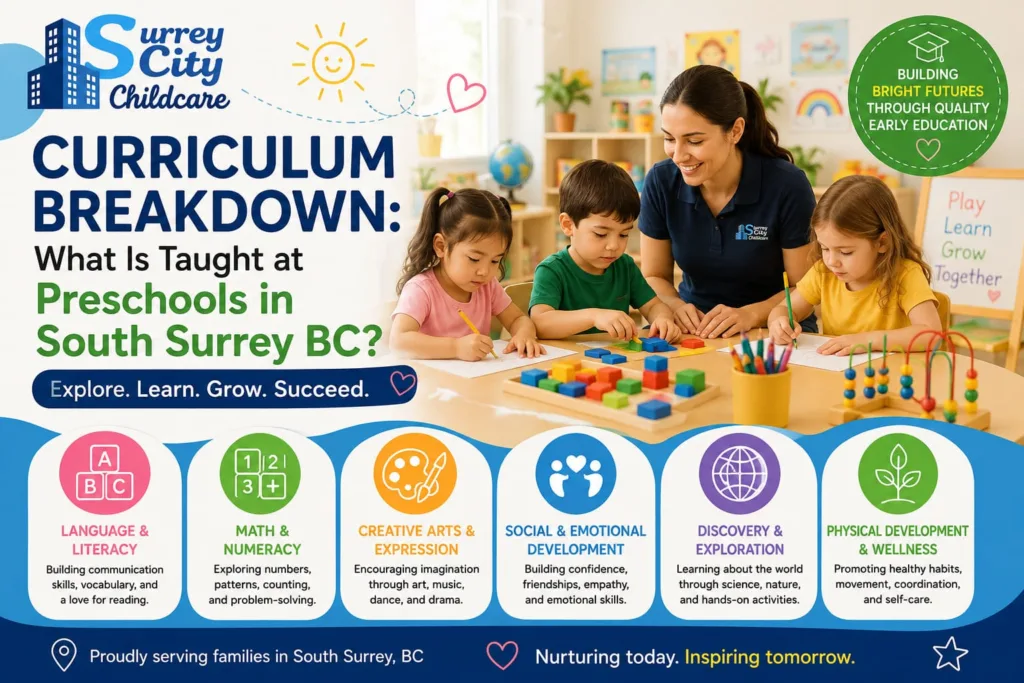
1. Social and Emotional Learning (SEL)
Before a child can focus on letter sounds or number recognition, they must feel emotionally secure and socially capable. Social and emotional learning forms the bedrock of any reputable south surrey preschool curriculum.
In the classroom, educators actively teach co-regulation and emotional awareness. Children are guided to identify their feelings, use descriptive language to express frustration, and navigate peer conflicts constructively. Daily group activities provide continuous opportunities to practice essential social habits, including:
- Sharing materials and taking turns during interactive play.
- Recognizing facial expressions and demonstrating empathy toward peers.
- Developing self-regulation skills to transition smoothly between high-energy play and quiet rest.
- Following multi-step classroom routines independently, such as hanging up backpacks and preparing for snack time.
2. Language, Early Literacy, and Expressive Communication
Early literacy is much more than reciting the alphabet. It encompasses listening comprehension, vocabulary acquisition, phonological awareness, and symbolic understanding. In a language-rich environment, children are immersed in spoken and written communication throughout the day:
- Storytelling Circles & Songs: Interactive puppet shows and rhyming songs teach sound patterns and cadence.
- Open-Ended Prompts: Discussions encourage toddlers to articulate their thoughts, describe their creations, and ask questions.
- Fine Motor Readiness: Squeezing playdough, threading beads, and painting build hand strength for proper pencil grip later on.
3. Early Numeracy and Mathematical Thinking
Mathematical concepts in early childhood are best understood through physical manipulation rather than abstract symbols on a page. Children explore mathematical relationships using concrete objects, discovering patterns, spatial relationships, and quantities through direct experience:
- Sorting & Classifying: Grouping loose parts (e.g., buttons, rocks, or counting bears) by color, shape, or size.
- Spatial Awareness: Building block structures to explore balance, height, symmetry, and geometry.
- Measurement & Volume: Filling and pouring sand or water into containers to understand capacity and weight.
- Pattern Recognition: Creating visual sequences using colored beads, blocks, or natural materials.
4. Scientific Inquiry and Environmental Exploration
Young children are natural scientists who constantly observe, test hypotheses, and draw conclusions. A modern curriculum nurtures this intrinsic curiosity by offering regular opportunities for hands-on discovery:
- Science Centers: Feature magnifying glasses, light tables, propagation stations, and natural specimens.
- Hands-on Experiments: Children investigate cause-and-effect by mixing colors, observing ice melting, or tracking seed growth.
- Outdoor Exploration: Outdoor play extends inquiry into the natural world, fostering environmental awareness as children explore seasonal changes and local ecosystems.
Educational Philosophies: Comparing Classroom Models
As parents evaluate different centers, they will encounter distinct pedagogical philosophies. Understanding these models helps families choose the environment that best matches their child’s learning style:
Play-Based Learning
A play based preschool south surrey center operates on the principle that play is the primary vehicle for development. Activities are largely child-led and educator-guided. Teachers observe children’s natural interests and introduce materials or questions that extend their learning. Example: If toddlers show an interest in bridges, the educator might introduce books on architecture, provide wooden planks, and discuss structural stability during play.
Reggio Emilia Inspired
The Reggio Emilia approach views the physical environment as the “third teacher”. Classrooms emphasize natural light, neutral colors, and open-ended materials rather than bright plastic toys. Documentation is a key component—educators capture children’s spoken words, drawings, and building projects on wall displays to make their learning visible to families.
Montessori Method
Montessori classrooms feature child-directed activity, mixed-age groupings, and specialized self-correcting learning materials. Children choose activities from open shelves and work independently or in small groups at their own pace. The curriculum heavily emphasizes practical life skills (e.g., pouring water, buttoning coats) alongside sensory and academic materials.
Bridging the Gap to Primary School
The ultimate goal of any early learning curriculum is to ensure a smooth, confident transition into the public school system. In British Columbia, Kindergarten teachers consistently emphasize that school readiness is rooted in self-reliance, social adaptability, and emotional resilience rather than early academic drilling.
When reviewing daycares in surrey and dedicated early learning facilities, parents should look for programs that systematically foster personal independence. Children who can put on their own outdoor gear, manage their lunch containers, ask for help, and focus on a task for sustained periods adjust far more successfully to Kindergarten.
Balancing Logistics: Schedules, Costs, and Options
Finding the ideal learning setting requires balancing educational quality with family logistics and financial planning.
Program Formats and Scheduling Flexibility
Early childhood centers offer various scheduling formats. Some families thrive with a traditional part-time morning routine, while working parents often require a full day preschool south surrey program that seamlessly combines structured early education with extended care hours. Evaluating your daily commute and commitments ensures a schedule that remains sustainable over the long term.
Understanding Fees and Subsidies
Navigating south surrey preschool fees is a central consideration for growing families. Tuition rates vary depending on facility type, educator qualifications, staff-to-child ratios, and included amenities.
When researching an affordable preschool south surrey location, check whether the provider participates in provincial support systems such as:
- Child Care Fee Reduction Initiative (CCFRI): Directly lowers monthly tuition fees.
- Affordable Child Care Benefit (ACCB): An income-tested provincial subsidy for qualifying families.
Accessing Regional Support Resources
Navigating early years care can feel complex, but families do not have to do it alone. Utilizing community resources such as options childcare surrey services can provide valuable guidance on licensed provider listings, waitlists, and subsidy applications.
For families searching online for a reliable daycare near me surrey, proximity to major transit corridors and daily work routes is often just as important as the classroom curriculum. Selecting an accessible center minimizes commuting stress and allows for calm, predictable drop-offs.
Frequently Asked Questions
What is the ideal age for a child to begin a formal preschool program?
Most children enter a formal program between the ages of 2.5 and 3 years old. At this stage, toddlers generally demonstrate an increased interest in playing alongside peers, can follow simple verbal directions, and are developing the emotional foundation necessary to spend time away from home.
How do educators assess a toddler’s progress without using traditional grades?
Progress is tracked using observational documentation, developmental checklists, and learning portfolios rather than formal tests or grades. Educators regularly record notes, take photographs, and collect work samples to track growth in fine motor control, social interaction, communication, and problem-solving over time.
What local coverage areas and neighborhoods do your early learning services support?
Our early learning services directly support families across Surrey and surrounding regional communities, including South Surrey, Whalley, Guildford, Fleetwood, Newton, and Cloverdale. Our accessible central location makes drop-offs and pick-ups convenient for parents commuting throughout the Lower Mainland.
What is the administrative response time for families asking about space availability?
Our enrollment office responds to all inquiries, tour requests, and space availability questions within 1 to 2 business days. We maintain clear, prompt communication to help parents plan their return-to-work timelines and childcare arrangements without unnecessary delays.
How does a play-based curriculum teach foundational mathematics and reading?
Play-based learning integrates academic concepts into meaningful, hands-on activities. Early reading skills are developed through storytelling, rhyming games, and environmental print exposure, while mathematical concepts are taught through sorting objects, measuring ingredients during sensory play, and recognizing patterns in building blocks.
Final Thoughts: Investing in Your Child’s Future
Choosing an early childhood program is about finding a community that recognizes your child’s unique worth, encourages their natural curiosity, and supports their holistic growth. By evaluating programs based on their curriculum depth, social-emotional focus, and alignment with the BC Early Learning Framework, you can select an environment that sets the stage for a lifetime of confident learning.
As a trustworthy, customer-focused, and professional early care provider, Surrey City Childcare remains dedicated to serving families seeking exceptional care and preschools in south surrey bc. Located at 12250 100 Ave, Surrey, BC V3V 2X1, Canada, our certified educators combine structured curriculum goals with warm, nurturing guidance to ensure every toddler thrives. Reach out to our admissions team today to schedule a personal classroom tour, review our pedagogical frameworks, and reserve a space where your child can grow, learn, and excel.