
Quick Summary
- Demystifying Provincial Financial Assistance: The affordable childcare benefit is an income-tested provincial program in British Columbia designed to reduce out-of-pocket monthly care costs for eligible families.
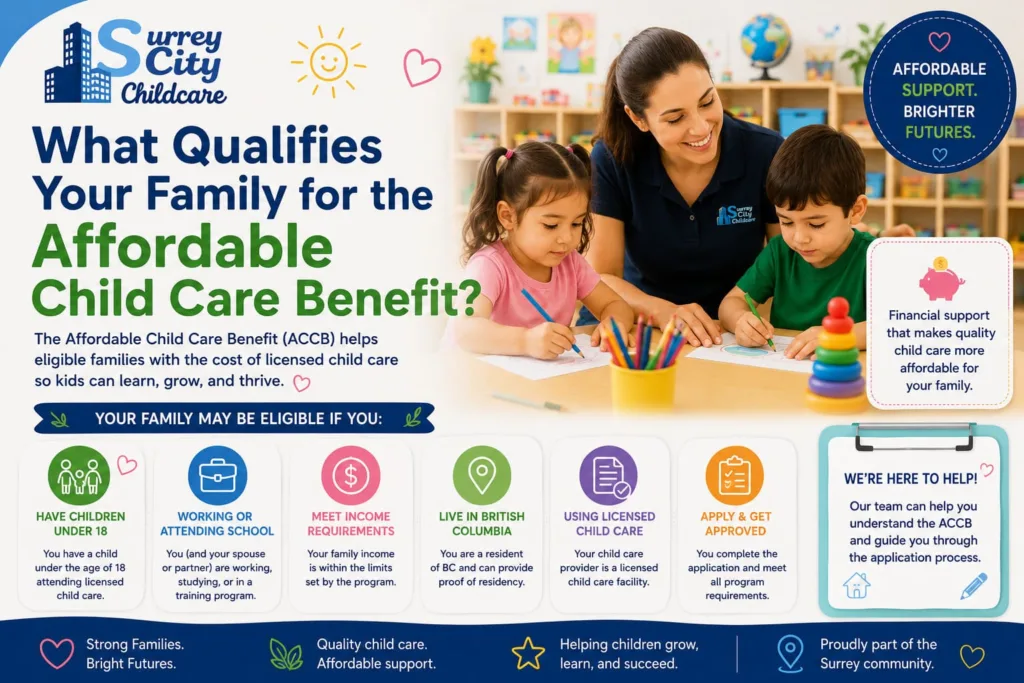
- Understanding Core Qualification Metrics: Eligibility relies on meeting specific household income thresholds, holding valid BC residency, using eligible care providers, and establishing an approved reason for care.
- Evaluating Income Limits and Deductions: Families earning up to $111,000 annually can qualify, with additional income deductions available based on family size and support needs.
- Maximizing Savings Across Age Groups: Funding amounts vary by age category, offering the highest financial support for infants and toddlers in licensed group environments.
- Combining Provincial Programs: Eligible families can combine direct-to-parent benefits with provider-level fee reductions to significantly minimize overall monthly childcare expenses.
Raising a young family in the Lower Mainland requires balancing daily work obligations, household finances, and high-quality early childhood care. For parents across Surrey, managing monthly living costs while securing a spot in a top-tier early learning program can feel challenging. Fortunately, British Columbia provides robust financial support structures to help families access quality care without overextending their domestic budgets. The primary provincial safety net is the affordable childcare benefit, an income-tested government grant that pays funding directly to licensed care providers to lower a family’s monthly invoice.
At Surrey City Childcare, our administrative team serves as a reliable, affordable, and professional partner for local parents seeking guidance on applying for the affordable childcare benefit. Conveniently located at 12250 100 Ave, Surrey, BC V3V 2X1, Canada, our central facility combines high-quality early education programs with complete administrative transparency, helping families navigate provincial funding options with total ease and confidence.
Understanding the Framework Behind Provincial Childcare Subsidies
The British Columbia provincial government created the Affordable Child Care Benefit (ACCB) to ensure that financial constraints never stand between a young child and high-quality early learning. Unlike blanket tax credits or end-of-year tax deductions, this program delivers direct, monthly fee relief to lower out-of-pocket tuition costs for parents. Understanding how this funding functions is essential for any family planning their return to work or school.
The program operates under specific statutory criteria established by the Ministry of Education and Child Care. Rather than issuing a flat dollar amount to every household, the province calculates benefits on a sliding scale. This calculation takes into account a household’s net income, the number of dependents, the age of the child requiring care, and the specific type of care facility selected. For families residing across Surrey, verifying eligibility before enrolling in a center provides clear financial predictability, allowing parents to budget accurately for the year ahead.
The Essential Residency and Citizenship Requirements
Before evaluating household income or care schedules, applicants must meet baseline residency criteria set by the province. The provincial government requires that the primary applicant’s parent or legal guardian live in British Columbia and maintain a permanent residential address within the province.
Additionally, applicants must establish legal status in Canada. To meet the baseline criteria, the applying parent or legal guardian must fall into one of the following legal categories:
- Canadian citizens holding valid citizenship documentation.
- Permanent residents of Canada with valid landing paperwork or permanent resident cards.
- Convention refugees or protected persons recognized under federal immigration law.
- Temporary residents who have resided in Canada throughout the previous eighteen consecutive months with valid permit coverage.
Both the applicant parent and their cohabiting spouse or common-law partner must provide valid Social Insurance Numbers (SIN) during the electronic application process. This allows the province to verify annual household earnings directly through Canada Revenue Agency tax data.
Approved Reasons for Care: Why Your Family Needs Childcare
Meeting the basic residency and citizenship standards is the first step in the qualification process. Next, the province requires parents to demonstrate a recognized reason for needing care. The government establishes these categories to ensure funding supports families who require care for professional, educational, or medical reasons.
To satisfy the reason for care requirement, at least one of the following criteria must apply to the parents or legal guardians in the home:
1. Gainful Employment or Self-Employment
Parents who work full-time, part-time, or seasonal jobs meet the primary threshold for funding. Self-employed individuals who operate registered businesses or work as independent contractors also qualify. When applying, working parents provide pay stubs, employment confirmation letters, or business registration documents to verify their active work schedules.
2. Enrollment in Education or Vocational Training
Parents attending recognized high schools, universities, community colleges, or certified vocational institutes satisfy the provincial criteria. Whether completing a degree, taking professional development courses, or learning English as a second language, educational enrollment qualifies a family for childcare support during class hours and study periods.
3. Active Job Search Activities
If one parent in a two-parent household is employed while the other is actively looking for work, the family can receive funding while searching for employment. Single parents who are unemployed and actively seeking work can also receive coverage to attend interviews, submit applications, and connect with career counselors.
4. Medical Conditions Impacting Parental Care
Families facing health challenges receive support when a medical condition prevents a parent from providing full-time care for their child. A licensed medical practitioner completes a standard medical form confirming that the parent’s condition interferes with daily parenting responsibilities, ensuring the child remains supported in a safe learning environment.
5. Enrolling a Child in Licensed Preschool
Children who attend a licensed preschool program automatically satisfy the reason for care requirement. The province recognizes that early childhood education benefits child development, meaning parents do not need to prove employment or student status if their child attends an established preschool program.
Household Income Thresholds and Financial Deductions
Financial assessment is a core component of the provincial application process. The government sets specific childcare subsidy income limits to distribute funding equitably across the province. Generally, families with an annual adjusted net income under $111,000 may qualify for full or partial financial support.
To calculate a household’s adjusted income, the province starts with the net income reported on the previous year’s Canada Revenue Agency Notice of Assessment. However, the government applies important financial adjustments to reflect true family living expenses:
- Family Size Adjustments: Annual household income is reduced by $2,000 for each family member beyond the first two individuals. A family of five receives significantly greater income adjustments than a family of three.
- Support Needs Adjustments: Annual income is further reduced by $3,000 for each child in the home who has designated special or extra support needs.
Families with an adjusted net income under $45,000 typically qualify for the maximum allowable monthly benefit rate, bringing their out-of-pocket childcare fees close to zero in many care settings. Families earning between $45,000 and $111,000 receive partial benefits on a sliding scale, ensuring that moderate-income households still receive valuable monthly financial relief. This structure ensures that low income daycare funding reaches the families who need it most, while expanding access to middle-income parents facing high urban living costs.
Care Categories and Maximum Benefit Allocations
The amount of funding a qualified family receives depends heavily on the age of the child and the type of care facility selected. Licensed care facilities that meet strict provincial health and safety standards receive the highest monthly benefit rates.
Infant and Toddler Care (Under 36 Months)
Infant care requires lower staff-to-child ratios and specialized nursery equipment, making it the highest-cost category for early learning centers. To offset these costs, the province provides an affordable infant childcare subsidy that delivers up to $1,250 per month per child in licensed group care. For toddlers aged 19 to 36 months, maximum funding rates reach up to $1,060 per month, significantly lowering the financial hurdle for parents returning from parental leave.
Children Aged Three Years to Kindergarten Entry
Once a child turns three, maximum benefit rates adjust to reflect changing classroom staff ratios. Families with children aged 37 months up to school age can receive up to $550 per month in a licensed daycare subsidy setting. This ongoing support helps parents maintain uninterrupted care right up until their child transitions into elementary school.
School-Age Care and After-School Programs
Financial assistance continues after a child enters primary school. Working parents who require care before and after regular elementary school hours can access an after school care benefit that provides up to $210 to $415 per month, depending on the care structure and total hours enrolled.
Layering Subsidies: Combining CCFRI and ACCB for Maximum Savings
Understanding how different funding programs interact is key to maximizing overall childcare savings in British Columbia. Parents often confuse the Affordable Child Care Benefit with the Child Care Fee Reduction Initiative (CCFRI), but these are two separate, complementary programs.
The Child Care Fee Reduction Initiative is a provider-level funding model. Participating licensed centers receive operational funding directly from the province to reduce tuition fees for all enrolled families, regardless of household income.
When a family qualifies for individual, income-tested funding, that amount is applied after the initial provider-level fee reduction has been subtracted from the monthly tuition invoice. Layering these subsidized child care programs together allows eligible lower- and middle-income families to reduce their monthly childcare expenses down to minimal amounts or even zero out-of-pocket costs.
For parents searching for affordable day care options near me, selecting a center that actively participates in provincial reduction initiatives and offers direct support for benefit applicants guarantees the lowest possible monthly expense.
Step-by-Step Application Guide: Submitting via My Family Services
Applying for funding is a straightforward electronic process completed through the province’s secure online system. Following a methodical, step-by-step submission approach prevents processing delays and ensures payments begin on time.
Step 1: Secure a Childcare Space
Before starting the government application, you must confirm a spot at a recognized care facility. The application requires specific details about the facility, including license numbers and monthly fee schedules.
Step 2: Complete the Child Care Arrangement Form
Your chosen facility manager completes an official Child Care Arrangement Form (CF2900). This form details your child’s schedule, enrollment date, and baseline monthly fee structure, serving as official confirmation of your care arrangement.
Step 3: Gather Supporting Financial and Personal Documents
Collect all necessary documentation before logging into the portal. You will need your Social Insurance Number, recent tax Notice of Assessment, proof of BC residency (such as a utility bill or driver’s license), and documentation supporting your reason for care (such as pay stubs or school schedules).
Step 4: Submit the Application via the My Family Services Portal
Log into the My Family Services portal using a secure BC Services Card account. Upload your supporting documents, attach the completed Child Care Arrangement Form, and complete the digital submission.
Applications must be submitted before the end of the month in which care begins to receive coverage for that entire month. Submitting an application mid-month covers the full calendar month, whereas submitting one day late delays funding eligibility to the following month.
Frequently Asked Questions
Document Submission Procedures for Self-Employed Parents
Self-employed parents submit their most recent CRA Notice of Assessment along with Statement of Business Activities forms (T2125). If the business is newly established, applicants can provide a declared income statement accompanied by recent client invoices, business bank statements, or contracts to confirm active commercial operation.
Application Processing Timelines and Local Administrative Support
Electronic applications submitted through the My Family Services portal are typically processed within ten to fifteen business days, provided all required documentation is attached. Our administrative office at Surrey City Childcare assists enrolled families by completing arrangement forms within twenty-four hours to ensure swift processing.
Regional Service Coverage and Neighborhood Access
Our central facility directly serves families across the surrounding Surrey region, including Whalley, City Centre, Guildford, Fleetwood, Newton, and North Surrey. Families commuting along major transit corridors access our location easily for drop-off and pick-up routines.
Annual Renewal Schedules and Circumstance Updates
Provincial benefit approvals remain active for up to twelve months. Recipients must renew their application annually, ideally thirty days prior to the expiration date listed on their confirmation letter. Any changes in household income, marital status, or care hours must be reported immediately through the portal.
Funding Adjustments for Part-Time Care Schedules
The provincial government calculates benefit rates based on the total number of care hours required each month. Children attending part-time schedules receive prorated funding amounts aligned with their weekly attendance, ensuring fair benefit distribution matched to actual usage.
Final Thoughts: Accessing Quality Care for Your Child
Navigating provincial funding frameworks empowers families to make informed choices about early childhood education. By understanding eligibility rules, income thresholds, and required application forms, parents can secure substantial monthly financial relief. Securing financial assistance removes barriers to high-quality early childhood environments, giving your toddler access to supportive social settings, language-rich play spaces, and essential school readiness routines.
As a reliable, affordable, and professional service provider, Surrey City Childcare remains committed to supporting local families through every stage of the enrollment process. Located at 12250 100 Ave, Surrey, BC V3V 2X1, Canada, our team assists parents in navigating every detail of the affordable childcare benefit while delivering top-tier care for young learners. Reach out to our admissions office today to schedule a personal tour, check classroom availability, and learn how our community-focused facility can support your family’s needs.