
Quick Summary
- Sun-Drenched Learning: Discover how our south surrey preschool leverages the gorgeous July weather to transform the traditional classroom into dynamic outdoor learning spaces.
- The Power of Inquiry: Learn how “Forest and Garden Inquiry” fosters curiosity, problem-solving skills, and a genuine love for nature in early learners.
- A Holistic Approach: Understand how outdoor exploration benefits a child’s physical health, social connections, emotional well-being, and cognitive growth simultaneously.
- Connecting with Community: See how we integrate elements of our beautiful local Surrey environment into daily learning routines, fostering a strong sense of place.
- Beyond Just Play: Realize that these outdoor experiences, while incredibly fun, are carefully guided educational opportunities, not just “free time.”
The arrival of July in Surrey, British Columbia, brings a special kind of magic. The days are long, the sun is warm, and the entire natural world seems to be in full, glorious bloom. For parents, it’s a time of creating memories, from beach trips to backyard barbecues. In the world of early childhood education, however, this beautiful summer weather is more than just a pleasant backdrop; it’s a powerful, dynamic tool that we leverage to create profound learning experiences. For families searching for a south surrey preschool that understands and embraces this, this seasonal shift opens the door to unparalleled educational opportunities.
At our core, we believe that learning should not be confined by four walls, especially during the vibrant summer months. The BC Early Learning Framework encourages educators to move beyond traditional settings and view the environment itself as a co-teacher. When the weather cooperates as beautifully as it does in July, our licensed preschool south surrey takes this philosophy literally, stepping outside to explore, discover, and learn directly from the earth.
While many preschools in south surrey bc offer excellent programs, our distinct focus on weaving environmental inquiry into the daily curriculum, particularly during the summer, is what truly sets us apart. We are proud to be a reliable and professional service provider, deeply rooted in the Surrey community, helping children develop a foundational love for learning through direct, immersive interaction with the natural world. Our facility at 12250 100 Ave, Surrey, BC V3V 2X1, Canada serves as the ideal launchpad for these outdoor adventures, conveniently located for families seeking top-tier early childhood education in the region.
The Seasonal Catalyst: Why July Matters in Early Inquiry
Why July? What makes this specific month such a potent time for learning? The answer lies in the intense activity taking place in the natural environment. While winter offers unique lessons on decomposition and seasonal cycles, July is a time of peak growth, vibrant colour, and abundant life. The warmth and consistent sunlight act as a catalyst, accelerating biological processes that children can observe in real-time.
A garden is not just a garden in July; it is a bustling metropolis of insect life, a laboratory of photosynthetic processes, and a visual symphony of textures and scents. A forest is not just a collection of trees; it is a complex, thriving ecosystem where children can witness the intricate relationships between plants, animals, and the physical world. This density of sensory information provides endless fuel for a child’s curiosity. For a preschool in south surrey, July isn’t a time to retreat indoors to air-conditioned classrooms; it’s the ultimate invitation to step outside and explore.
Our approach, heavily influenced by nature based early learning surrey principles, thrives in this environment. We see the sunshine as a key element that enables deeper, more prolonged, and safer exploration of the world around us.
The Nature of Inquiry: Understanding the “What” and “How”
Before delving into the specific activities, it’s crucial to understand what we mean by “Forest and Garden Inquiry.” Inquiry-based learning isn’t just about doing activities outdoors. It’s a profound pedagogical shift away from passive, lecture-style instruction towards an approach that places the child—and their questions—at the very center of the educational process.
We don’t tell the children what they are going to learn; instead, we follow their gaze. If a child stops to examine a ladybug on a leaf, we don’t rush them along. We stop too. We ask open-ended questions: “Where do you think it’s going?” “Why do you think it likes this specific plant?” “How many spots can you count?” These questions don’t have a single, simple answer. They encourage observation, hypothesis formation, and critical thinking.
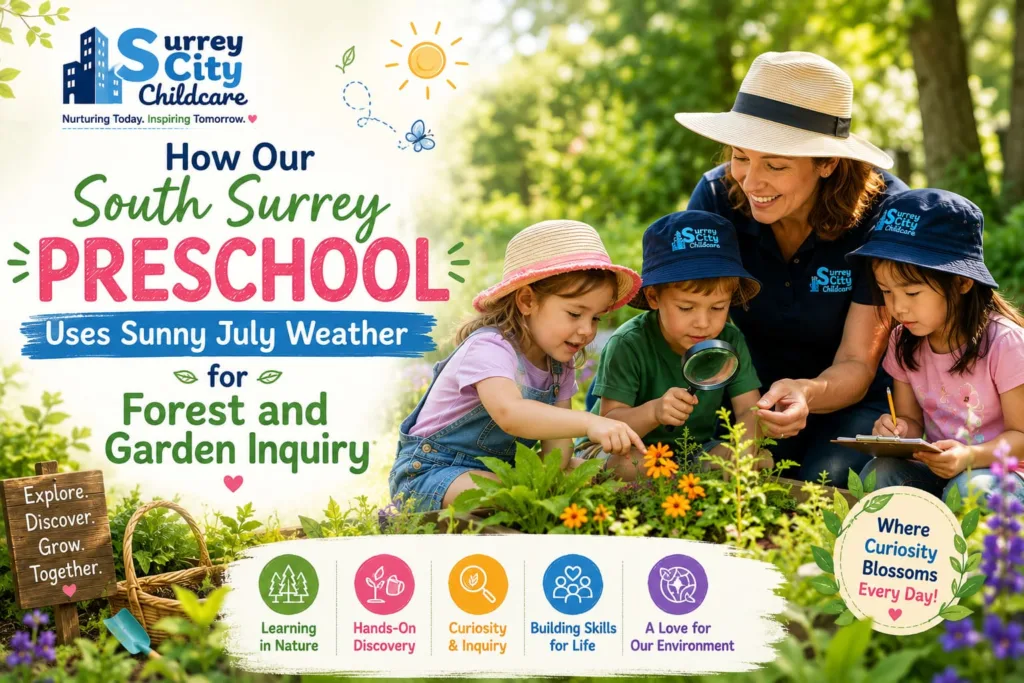
The educators in our south surrey preschool are not just instructors; they are keen observers, skillful facilitators, and enthusiastic co-learners. They create rich, stimulating environments, both in our planned garden spaces and during excursions into local natural areas, and then carefully observe where the children’s attention is drawn. We provide the tools for this exploration: magnifying glasses, sketchbooks for observational drawing, child-safe trowels for digging, and field guides to help identify local flora and fauna. By validating their curiosities, we empower children, making them active participants in their own education rather than passive recipients of information.
Garden Inquiry: Cultivating Science, Sustainability, and Stewardship
The preschool garden is perhaps our most potent July classroom. It offers an contained yet incredibly complex microcosm of the natural world, allowing children to observe and interact with biological processes safely and frequently.
The Seed-to-Table Connection
During June, many of the lessons focus on patience, planting, and nurturing young seedlings. In July, the payoff arrives, and the inquiries take on a more dynamic, immediate tone. Children can observe how consistent sunshine and proper watering literally transform a tiny green sprout into a thriving zucchini plant or a cascading waterfall of cherry tomatoes.
This process provides a rich avenue for understanding causality, life cycles, and nutrition. Inquiry blossoms: “Why do some plants need more water than others?” “What happens if we leave this leaf in the shade?” These observations don’t just teach biology; they build a profound connection to the food they eat. Harvesting a handful of sugar snap peas they helped grow and then eating them at snack time is a sensory experience that no classroom lecture can ever replace. It fosters an early appreciation for the effort that goes into food production and lays the foundation for healthy, sustainable eating habits.
A Biodiversity Hotspot: Pollinators and Pests
A thriving July garden is a magnet for insect life, and our preschoolers are enthusiastic entomologists. Instead of viewing bugs as scary or inconvenient, we view them as essential components of a working ecosystem.
When a child spots a bee on a lavender bloom, it launches an entire inquiry into pollination. We discuss the vital role bees, butterflies, and other pollinators play in creating the fruits and vegetables we love. We might ask, “Can you see the yellow dust (pollen) on its legs?” Conversely, discovering aphids on the rosebushes doesn’t lead to panic but rather to discussions about pests and beneficial insects, like ladybugs, which are natural predators. These real-world observations teach complex ecological concepts about food chains, interdependence, and natural balance in a way that is immediately accessible and deeply engaging.
Forest Inquiry: Navigating Complexity, Resilience, and Responsibility
While the garden is a constructed environment, the local forests in Surrey offer a fundamentally different, more complex, and less predictable experience. Forest inquiry takes the foundational skills of observation and hypothesis-making developed in the garden and applies them to a vast, untamed landscape.
Mastering the Physicality of Space
July’s firm, dry ground provides the ideal foundation for children to build physical competence and assess risk—a critical skill championed in early learning. Walking on a flat, even surface, like our classroom or garden path, requires a specific set of motor skills. Navigating a forest trail, with its twisting roots, loose rocks, the gentle give of forest floor loam, and the varied incline, demands much more from a child’s developing body.
Forest inquiry encourages physical problem-solving: “How can I balance on this log?” “What’s the safest way to step over this large root?” This isn’t just about physical exercise; it’s about proprioception (understanding where one’s body is in space), balance, coordination, and building self-confidence. Children learn their own physical limits, discover the unique sensory feedback of different natural materials, and develop resilience as they navigate challenges. The firm footing allowed by July’s dryness means we can venture deeper and tackle more varied terrain safely, unlocking richer areas for exploration.
Ecological Interdependence and Seasonal Shifts
The July forest is vastly different from the winter forest, and our inquiry frequently focuses on these seasonal changes. We encourage children to observe the canopy cover—how the thick July leaves create cool patches of shade, filtering the intense sunlight and creating microclimates. We might ask, “Why do you think it feels cooler under the trees?”
This exploration naturally extends to observing where the animals go during the heat of the day. Children learn to look for tracks in shaded areas near natural water sources or notice which birds are active in the dense brush. This fosters a deeper understanding of ecosystem management and how different species adapt to varying conditions. Inquiry here deepens connections: “Where do you think the squirrels are hiding from the sun?” “Why is the ground damp here but dry on the trail?” These discussions build critical thinking skills while fostering a sense of place and connection to the unique ecology of British Columbia.
The Synergy of Holistic Development: Why Inquiry Works
The beautiful thing about this inquiry-based, nature-centric approach is that it simultaneously addresses multiple domains of a child’s holistic development, seamlessly blending education with enjoyment.
Cognitive Connections: Building the Foundation for Math and Science
When preschoolers are outdoors, they are constantly categorizing, comparing, measuring, and hypothesizing. They count petals, sort smooth river stones from rough granite, predict whether a piece of bark will float, and observe patterns in spiderwebs. They are, essentially, developing the foundational skills required for mathematical and scientific thinking. However, because these lessons are delivered through hands-on interaction and fueled by their own curiosity, they are retained more deeply than lessons learned from worksheets or rote memorization. The sunny July weather ensures these lessons are active, engaging, and never feel like “work.”
Physical Well-being: Movement, Motor Skills, and Health
Beyond the obvious physical exertion of walking, climbing, and exploring, outdoor time is vital for overall health. July’s abundance of sunlight provides essential Vitamin D, which is crucial for bone development. Furthermore, navigating varied terrain, handling diverse natural textures, and manipulating small objects (like smooth stones or seeds) develop both gross and fine motor skills. This type of active, self-directed movement is fundamental for physical health and creates positive early associations with exercise and outdoor activity.
Social and Emotional Growth: Cooperation, Resilience, and Regulation
Forest and garden inquiry isn’t always a solitary pursuit. Children frequently collaborate, whether it’s working together to move a heavy log, sharing findings, or collectively solving a problem. This fosters teamwork, negotiation, and communication skills. Furthermore, the natural world, with its unpredictable elements and inevitable “setbacks” (like a garden plant not producing or a chosen trail being blocked), is a powerful teacher of resilience and adaptability. Perhaps most importantly, natural environments have a naturally calming and regulating effect, reducing stress and anxiety and providing a vital space for children to practice self-regulation away from the structured, sometimes over-stimulating, indoor environment.
Conclusion: Investing in Curiosity and Community
When we choose to prioritize outdoor inquiry, particularly during the stunning July weather, we are not simply opting for a pleasant break. We are actively deciding to invest in a specific set of skills, values, and attitudes: curiosity, resilience, environmental stewardship, and a joyful, proactive approach to learning.
At Surrey City Childcare, we view these sun-drenched explorations not as extracurricular activities but as vital components of our educational mandate. We are proud to serve the families of Surrey as a reliable, affordable, and professional service provider, creating early learning experiences that are both academically sound and emotionally fulfilling.
We believe that by fostering this deep, foundational connection to the natural world right here in our beautiful Surrey, BC community, we are nurturing the future custodians of our planet and preparing children not just for kindergarten, but for a lifetime of confident, compassionate, and curious living. Our commitment is rooted in trust, customer focus, and a profound respect for the innate wisdom of children and the immense teaching power of the world around us.
Frequently Asked Questions
1. Are these outdoor programs safe for my child during the peak July sun?
A: We take sun safety incredibly seriously. Our outdoor activities are planned strategically, utilizing shaded garden areas and natural canopy cover in local forests. We enforce strict hydration breaks, ensure the use of hats, and advise parents on appropriate sun-protective clothing and sunscreen application before drop-off. If temperatures reach extreme levels, outdoor time is adjusted, shortened, or conducted only during cooler morning hours.
2. Can I use the affordable childcare benefit for my child’s enrollment in your preschool programs?
A: Yes, absolutely. We are a licensed preschool south surrey, and our programs, whether focused on nature inquiry, early literacy, or social skills, are fully eligible for the British Columbia Affordable Child Care Benefit (ACCB). This provincial subsidy is income-tested and designed to help families cover the costs of licensed care, making high-quality early childhood education accessible.
3. What local coverage areas and neighborhoods do your early learning services support?
A: Our services are deeply rooted in the Surrey community, directly supporting families across Surrey, North Surrey, Newton, Whalley, and, of course, South Surrey. Our convenient location at 12250 100 Ave allows us to serve diverse regional communities efficiently, providing an accessible and reliable surrey bc daycare and early learning center option for commuting families.
4. If I search online for childcare near me, what administrative response time can I typically expect?
A: We maintain a highly responsive administrative team, ensuring that all online inquiries, registration questions, tour requests, or space availability questions are addressed promptly, usually within one to two business days. We recognize that parents face time pressures when arranging childcare, and we are committed to providing the information you need efficiently and professionally.
Final Thoughts: Investing in Your Child’s Natural Potential
Choosing an early learning environment is a significant decision. We invite you to consider a program that moves beyond standard methods to unlock the immense potential found at the intersection of your child’s curiosity and the natural world. Our dedicated educators combine structured pedagogical goals with the dynamic opportunities provided by nature, ensuring that every sunny July day becomes a profound learning adventure. As a trustworthy, customer-focused, and professional organization, Surrey City Childcare remains committed to providing exceptional, affordable early childhood education.
If you are seeking a south surrey preschool that will truly nurture your child’s sense of wonder, prepare them with essential developmental skills, and connect them deeply to their local environment, we invite you to reach out to our enrollment team today to schedule a personal tour of our modern center. Experience firsthand how we transform sunlight, soil, and smiles into foundational life skills.