
Quick Summary
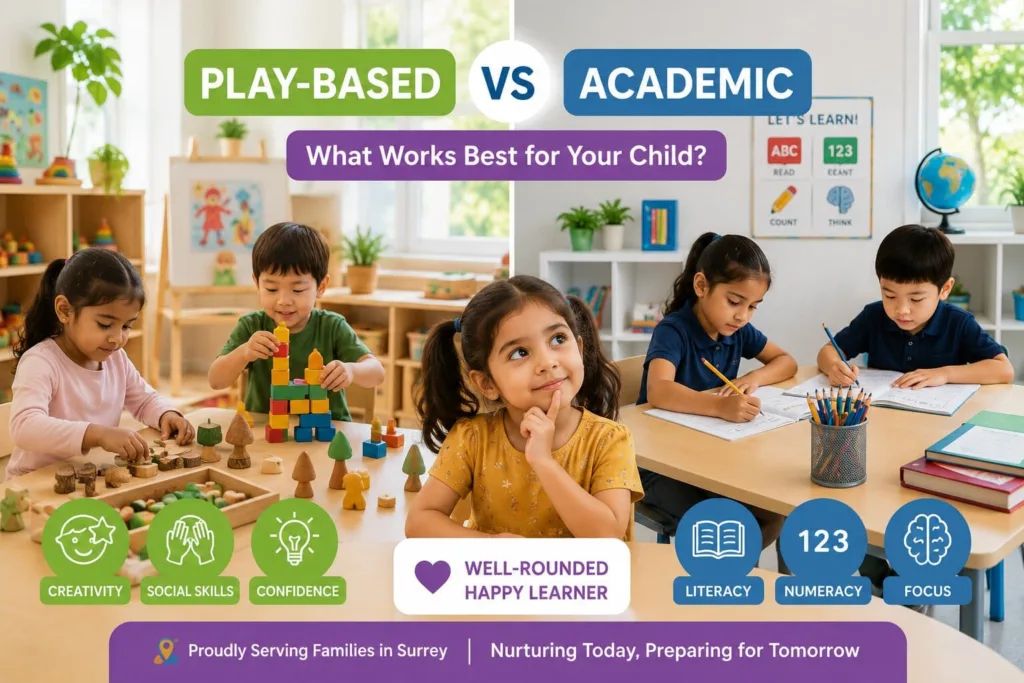
- Evaluating Philosophies: Explore the fundamental differences between play-based discovery and traditional academic instruction at a licensed preschool surrey families depend on.
- Cognitive and Social Growth: Understand how intentional, play-driven activities build essential executive function, emotional regulation, and problem-solving abilities far better than early rote memorization.
- Kindergarten Readiness Reality: Learn what British Columbia kindergarten educators actually look for on day one, including self-help independence and peer collaboration.
- Finding the Right Balance: Discover how blended models combine child-led exploration with educator-scaffolded early literacy and numeracy concepts.
- Practical Parent Checklist: Gain actionable advice on what to observe during facility tours to ensure an enriching, joyful early learning environment for your child.
Choosing the right educational foundation for your child is one of the most meaningful decisions you will make during their early years. As toddlers transition from home life into structured group care, parents often face conflicting advice regarding educational philosophies. Some advocate for early academic drills, phonics flashcards, and structured workbooks, while contemporary developmental science strongly favors inquiry, curiosity, and hands-on discovery. When evaluating a quality preschool surrey parents trust, understanding the real-world impact of play-based versus academic learning models helps you choose an environment where your child can flourish emotionally, socially, and intellectually.
As an established community leader in early education, Surrey City Childcare provides reliable, affordable, and professional early learning programs at 12250 100 Ave, Surrey, BC V3V 2X1, Canada, supporting families throughout Whalley, Guildford, Fleetwood, Newton, and nearby neighborhoods. By focusing on developmental milestones, responsive teaching, and proven early learning frameworks, modern early childhood centres help young learners build genuine enthusiasm for education. Examining how young brains absorb information allows parents to see why play-centred discovery remains the cornerstone of lifelong academic success.
1. Deconstructing the Two Philosophies: Play-Based vs. Academic
To make an informed decision, parents must first understand what these two educational models look like in daily practice. While both approaches aim to prepare children for future schooling, their methods, classroom environments, and developmental expectations differ dramatically.
The Academic Approach: Structure and Early Instruction
Traditional academic preschool models are typically teacher-directed. In these classrooms, the educator decides what every child will learn, when they will learn it, and how that learning is demonstrated. Daily routines often revolve around scheduled tabletop exercises, worksheets, repetitive drills, and structured group lessons focused on rote memorization.
- Teacher-Led Dynamic: The educator stands at the front of the room or directs children through uniform tasks, such as tracing letters or memorizing sight words.
- Product Over Process: Success is often measured by tangible outcomes, such as a completed worksheet or an identical craft project.
- Predetermined Milestones: Every child is expected to achieve specific academic benchmarks at the exact same chronological age, regardless of individual readiness.
While an academic curriculum may produce toddlers who can recite facts or identify letters early, research consistently demonstrates that early rote instruction does not translate into long-term academic advantages. In fact, premature academic pressure can sometimes lead to anxiety, frustration, and a reduced interest in independent problem-solving.
The Play-Based Approach: Inquiry, Agency, and Exploration
In contrast, a contemporary play based preschool surrey program is child-centred and educator-scaffolded. Rooted in the British Columbia Early Learning Framework, this approach recognizes that play is not a break from learning; it is the fundamental mechanism through which young children investigate the world around them.
In a play-based classroom, children choose from carefully curated learning centres filled with natural materials, sensory bins, wooden blocks, dramatic play costumes, and open-ended art supplies. Rather than passively listening to lectures, children actively touch, build, experiment, and collaborate. Educators act as thoughtful co-learners and guides, observing each child’s interests and introducing literacy, numeracy, and scientific principles organically within their play.
2. The Neuroscience of Play: How Young Brains Actually Learn
During the preschool years, between ages three and five, a child’s brain is forging millions of neural connections every day. Neuroscience reveals that young children do not learn best through passive reception; they build neural pathways through active, sensory-rich physical engagement.
Active Engagement and Neural Plasticity
When a child manipulates objects with their hands, their brain engages multiple sensory systems simultaneously. Stacking wooden blocks, pouring water into measured containers, or shaping clay activates spatial reasoning, motor control, and creative planning.
In a specialized toddler preschool surrey setting, hands-on sensory exploration triggers the release of dopamine and other neurotransmitters associated with positive memory retention. When learning feels joyful and self-directed, neural circuits become deeply ingrained, fostering genuine cognitive comprehension rather than superficial memorization.
Developing Executive Function and Self-Regulation
Executive function refers to the brain’s command center—the cognitive abilities that allow us to focus attention, remember multi-step instructions, control impulses, and balance multiple priorities. Studies in child psychology show that open-ended play is the single most effective way to build executive function in early childhood.
- Working Memory: Remembering the rules of an imaginative game or keeping track of which materials are needed to complete a fort.
- Cognitive Flexibility: Adapting when a block tower collapses and figuring out a new structural strategy without having an emotional breakdown.
- Inhibitory Control: Resisting the urge to grab a toy immediately and learning to wait for a peer to finish their turn.
Children who master executive functioning in early learning environments demonstrate superior academic achievement, emotional resilience, and social competence throughout elementary and high school.
3. What Does Learning Look Like in a Play-Centred Classroom?
Parents new to early learning often wonder how play translates into foundational skills like reading, mathematics, and scientific inquiry. In an intentional early childhood classroom, academic concepts are woven naturally into daily activities.
Early Literacy Without Worksheets
Literacy is far more than tracing letters with a pencil; it begins with phonemic awareness, expressive vocabulary, and a love for storytelling. In an accredited licensed preschool surrey facility, educators nurture literacy through rich language interactions:
- Storytelling and Dramatic Play: Acting out favorite stories in the costume corner teaches narrative structure, character perspective, and complex vocabulary.
- Print-Rich Environments: Labeling classroom shelving, creating visual daily schedules, and setting up pretend grocery stores with written shopping lists show children that text carries real-world meaning.
- Phonological Awareness: Singing interactive rhyming songs, clapping syllables in names, and playing sound-matching games build the auditory discrimination required for eventual reading.
Mathematics Through Sensory Inquiry
Abstract mathematical concepts become concrete when toddlers can touch and manipulate physical objects. Rather than completing numerical worksheets, children explore mathematical principles through play:
- Spatial Awareness and Geometry: Experimenting with geometric blocks, arches, and cylinders teaches balance, symmetry, and spatial relationships.
- Measurement and Volume: Scooping sand, pouring water through funnels, and comparing container sizes introduce volume, weight, and capacity.
- Patterning and Classification: Sorting leaves, buttons, and pinecones by color, shape, and size builds early algebraic thinking and analytical classification skills.
Scientific Discovery and Problem-Solving
Children are natural scientists driven by innate curiosity. A play-based curriculum encourages children to hypothesize, test theories, and observe outcomes:
- Mixing primary paint colors at the easel to discover how new shades are created.
- Observing plant growth in outdoor sensory gardens.
- Testing which objects sink or float in the water table.
By encouraging children to ask “why” and “what happens next,” educators cultivate critical thinking and intellectual curiosity that last a lifetime.
4. Rethinking Kindergarten Readiness: What Teachers Really Look For
A primary motivation for parents seeking an affordable preschool surrey program is ensuring their child is fully prepared for kindergarten. However, there is often a disconnect between what parents assume kindergarten requires and what elementary teachers actually prioritize.
When kindergarten teachers in British Columbia assess school readiness on the first day of class, they rarely worry about whether a four-year-old can read full sentences or write numbers up to one hundred. Instead, they focus on social, emotional, and self-help independence:
- Emotional Self-Regulation: Can the child manage frustration, transition between activities without intense distress, and self-soothe with gentle educator support?
- Communication Skills: Can the child express their physical and emotional needs clearly to an adult and listen to simple two- or three-step instructions?
- Social Collaboration: Can the child share materials, respect personal physical boundaries, and engage cooperatively with peers?
- Physical Independence: Can the child open their own lunch container, manage washroom routines, hang up their backpack, and put on their shoes?
A child who possesses strong self-regulation and social confidence will quickly master academic concepts in kindergarten. Conversely, a child who has been drilled academically but struggles with emotional regulation or peer cooperation will often find the social environment of elementary school overwhelming.
5. Choosing Between Full-Day and Half-Day Program Formats
When selecting an early learning center, families must also consider daily schedules and program formats that suit their child’s stamina and family lifestyle.
Full-Day Preschool Programs
Enrolling in a full day preschool surrey bc option provides children with an extended, unhurried rhythm. Full-day schedules allow ample time for deep, uninterrupted play cycles, outdoor exploration, nutritious group meals, and restful afternoon naps. For working parents requiring comprehensive daily coverage, full-day programs offer dependable routines that mirror the regular workday while maintaining enriching developmental care.
Half-Day Morning or Afternoon Sessions
For families seeking a gentle initial transition into group care, a half day preschool surrey schedule provides an ideal middle ground. Operating for two-and-a-half to four hours daily, half-day sessions focus on circle time, focused sensory stations, and peer socialization, giving young toddlers a stimulating taste of classroom life while leaving afternoons open for family routines.
Whether your schedule calls for part-time enrichment or comprehensive full-day care, selecting a dedicated center daycare that offers flexible program tiers ensures educational continuity tailored to your household.
Practical Tour Checklist: Evaluating Classroom Philosophy
When touring early learning facilities across the Lower Mainland, use this practical observation guide to determine whether a centre provides true child-centred learning:
- Classroom Noise and Energy: Look for a calm, joyful hum of conversation and productive activity rather than unnatural silence or chaotic shouting.
- Educator Posture and Interaction: Educators should be down on the floor or seated at child-sized tables, speaking at eye level with warmth and encouragement.
- Display of Children’s Artwork: Observe the classroom walls. Are there individual, creative art pieces reflecting diverse imaginations, or are there rows of identical, teacher-assembled crafts?
- Accessibility of Materials: Toys, art supplies, and sensory items should be stored on low, open shelves where children can make independent choices.
- Outdoor Play Environments: Look for safe, well-equipped outdoor areas that encourage gross motor movement, puddle exploration, and tactile engagement with nature.
Taking the time to observe these daily nuances gives parents complete confidence when selecting an accredited preschool in surrey bc for their little learner.
Finding trusted surrey childcare gives families reassurance that their child is receiving attentive, expert guidance in a welcoming community.
Frequently Asked Questions
How do play-based early learning classrooms assess a child’s progress without formal testing?
Educators use ongoing pedagogical documentation, including written observations, developmental milestone portfolios, and photo records of daily project work. These detailed portfolios track language growth, fine and gross motor mastery, and social-emotional development without subjecting children to stressful standardized testing.
What is the typical administrative response time when parents submit enrollment inquiries?
Our administrative team strives to respond to all website inquiries, registration forms, and tour requests within one to two business days. We provide clear details on current room availability, age groupings, tuition fee reductions, and registration procedures.
Which geographic neighborhoods and areas in Surrey do your programs cover?
Located at 12250 100 Ave, our facility serves families across Surrey and adjacent Lower Mainland communities. We regularly welcome children from Whalley, North Surrey, Guildford, Fleetwood, Newton, and South Surrey, providing a convenient, accessible hub for commuting parents.
At what age should a toddler transition from infant care into a structured preschool room?
Children typically transition into preschool rooms between 30 and 36 months of age, depending on their individual developmental readiness, communication confidence, and motor coordination. Educators collaborate closely with parents to ensure this transition happens smoothly and comfortably.
Final Thoughts
Early childhood is a brief, precious window that forms the bedrock for all future learning. When parents choose an early learning philosophy that respects the natural architecture of a child’s brain, they give their toddler the ultimate educational advantage: resilience, creative confidence, and a lifelong love for discovery. A high-quality preschool surrey program balances intentional play with loving guidance, ensuring every child steps into their future feeling capable, valued, and excited to learn.
As a trusted, affordable, and professional service provider, Surrey City Childcare remains dedicated to delivering premier early learning programs for local families. Our modern centre at 12250 100 Ave, Surrey, BC V3V 2X1, Canada offers safe, stimulating spaces guided by certified Early Childhood Educators who nurture young minds with patience and passion. We invite you to contact our team today to schedule a personal facility tour, meet our educators, and explore our exceptional early childhood programs.