
Quick Summary
- Early Language Foundations: Discover how using early literacy toys for toddlers helps expand vocabulary, improve articulation, and encourage early verbal expression during crucial developmental windows.
- Building Pre-Reading Skills: Learn how tactile play tools, story blocks, and sound-matching games strengthen phonemic awareness, phonics recognition, and listening comprehension.
- Integrating Fine Motor Strength: Understand the deep connection between fine motor hand dexterity—developed through threading and tracing toys—and eventual pencil control for early writing.
- Selecting Purposeful Play Materials: Explore age-appropriate, open-ended educational toys that encourage parent-child dialogue, creative storytelling, and sustained attention.
- Bridging Home and Classroom Learning: Discover how integrating speech-promoting toys at home aligns with the language-rich routines found in high-quality early learning environments.
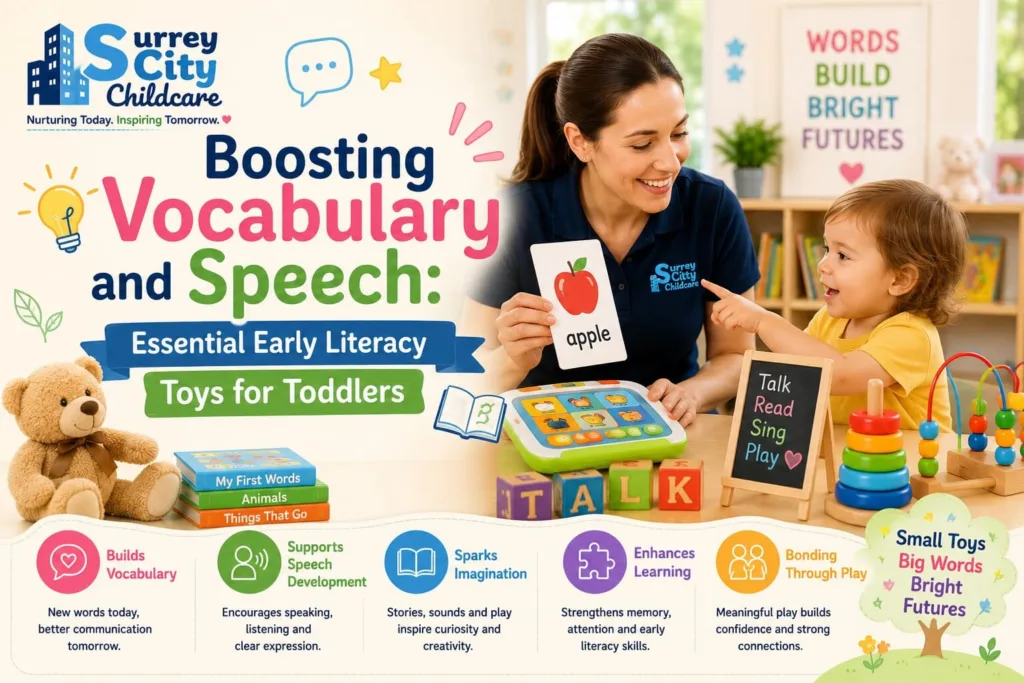
The toddler years represent an extraordinary explosion in language development. During this energetic stage of life, young minds transition from basic single words and simple babbling to complex sentences, inquisitive thoughts, and rich imaginative narratives. Parents often marvel at how quickly their young children absorb new phrases, imitate adult conversations, and make connections with the world around them. Introducing thoughtful, hands-on early literacy toys for toddlers plays a pivotal role in nurturing these emerging communication skills. Rather than relying on passive screens or overly complex electronic gadgets, the most effective learning tools encourage active dialogue, fine motor exploration, and open-ended creative discovery.
As an established community partner in early learning, Surrey City Childcare provides services rooted in evidence-based childhood development at 12250 100 Ave, Surrey, BC V3V 2X1, Canada and nearby areas. By pairing intentional play routines with warm, responsive caregiving, educators and parents can work together to build strong language foundations that last a lifetime. Equipping your home playroom with purposeful play materials creates a natural bridge between everyday family routines and structured group learning, ensuring your child feels confident expressing their needs, thoughts, and ideas.
The Science of Early Speech and Vocabulary Acquisition
To understand why specific play objects are so effective at building speech, it helps to look at how young brains process language. Toddlers do not learn to speak or read by memorizing flashcards in isolation. Instead, language development relies on a complex web of auditory processing, visual recognition, motor coordination, and social interaction.
When toddlers manipulate physical objects while hearing corresponding words, their neural pathways create stronger, more durable connections. This multi-sensory experience allows young learners to connect abstract auditory sounds with concrete physical realities. For example, holding a smooth wooden apple while hearing an adult pronounce the word creates a richer cognitive link than merely seeing a flat image on a television screen.
Early communication involves two distinct branches: receptive language (what a child understands) and expressive language (what a child can verbally communicate). Purposeful play tools stimulate both areas simultaneously. When a toddler follows instructions to place a blue block inside a wooden box, they exercise receptive skills. When they point to the block and call out its color or shape, they strengthen expressive speech.
Key Categories of Effective Early Literacy Toys
Not all educational tools offer equal learning value. The most beneficial literacy resources encourage interaction rather than passive observation. Selecting materials that grow alongside your child ensures long-term engagement and deep developmental impact.
1. Tactile Alphabet and Phonics Tools
Traditional wooden alphabet puzzles, textured letter cards, and sandpaper letters allow toddlers to experience the alphabet through touch and sight. Tracing the curve of a wooden letter with tiny fingers builds muscle memory while associating the physical shape with its unique phonetic sound.
Educators frequently recommend pairing letter recognition objects with real-world items. Matching a wooden letter “B” to a toy bear or a small ball reinforces initial consonant sounds, laying the groundwork for eventual reading fluency.
2. Storytelling Cubes and Picture Sequence Cards
Expressive language requires organizing thoughts into logical sequences. Picture cards depicting simple daily routines—such as waking up, brushing teeth, and eating breakfast—help toddlers understand narrative structure.
Story cubes featuring animals, vehicles, weather patterns, and everyday objects encourage children to invent original tales. Rolling a die and describing the picture shown prompts toddlers to construct descriptive sentences, expand their working adjectives, and practice conversational turn-taking with a parent or peer.
3. Fine Motor Pre-Writing Tools
Writing is an essential component of literacy, but before a child can write letters, they must build strength and dexterity in their hands, wrists, and fingers. Threading beads onto thick laces, squeezing playdough, and manipulating wooden pegs develop the pincer grasp required to hold a pencil correctly.
Tracing boards carved with smooth grooves allow toddlers to use wooden styluses or their index fingers to follow zig-zag lines, waves, and gentle loops. These repetitive movements build spatial awareness, hand-eye coordination, and fine motor control long before formal handwriting instruction begins.
4. Interactive Rhyming and Song Cards
Rhyme and rhythm are fundamental components of phonemic awareness—the ability to hear, identify, and manipulate individual sounds in spoken words. Sound blocks, rhyming match cards, and interactive musical instruments invite toddlers to explore cadence, emphasis, and sound repetition.
Singing traditional nursery rhymes while using corresponding props or finger puppets helps children anticipate word endings, recognize rhyming pairs, and remember multi-verse song lyrics, greatly expanding their auditory vocabulary.
Integrating Educational Toys into Daily Home Routines
Acquiring high-quality materials is only the first step. How parents introduce and interact with these play objects determines their true educational value. Creating an inviting, low-stress environment maximizes your toddler’s interest and confidence.
Practice Self-Directed Toy Rotation
A common challenge in modern households is toy overload. When a playroom floor is cluttered with dozens of brightly colored objects, toddlers can become overstimulated and lose focus quickly.
Implementing a simple toy rotation system keeps learning materials fresh and exciting. Display five to seven purposeful play items on low, open shelves where your toddler can access them independently. Rotate these items every few weeks based on your child’s shifting interests and developmental progress. This organized approach promotes sustained attention, deeper exploration, and independent cleanup habits.
Emphasize Conversational Narration
The most important complement to any play object is a responsive adult voice. Actively narrating what your child is doing enriches their language environment. If your toddler is stacking wooden blocks, describe their actions using varied vocabulary: “You are balancing that heavy red rectangle right on top of the tall square tower!”
Pausing after asking open-ended questions gives toddlers time to process auditory information and formulate a spoken reply. Allowing five to ten seconds of quiet response time shows your child that their words are valued, encouraging further verbal attempts.
Encourage Cooperative and Parallel Play
While independent exploration is important, language thrives in social settings. Playing alongside your toddler or arranging playdates with peers offers natural opportunities for conversational practice. Sharing materials, requesting specific items, and negotiating turns teach essential social-emotional communication skills that transition smoothly into group learning environments.
Aligning Home Learning with Professional Early Education
While home play routines form the cornerstone of early development, surrounding your child with a speech-rich group environment accelerates their progress even further. High-quality centers design their classrooms around open-ended exploration, daily circle-time discussions, and peer collaboration.
When parents choose educational toys for toddlers in surrey that mirror the hands-on materials used in professional early learning classrooms, children experience reassuring continuity between home and school. Objects such as loose parts, natural wooden blocks, sensory sand tables, and dramatic play costumes invite rich dialogue and imaginative roleplay.
Educators in a high-quality south surrey preschool understand how to weave vocabulary building into every moment of the day. Whether children are discussing the life cycle of a garden seed during outdoor inquiry or identifying rhyming words during storytime, intentional educator guidance transforms routine play into powerful learning milestones.
Investing in early learning toys surrey bc families trust helps children build crucial executive functioning skills, attention control, and emotional resilience. Combining structured home routines with dynamic group programs ensures every child feels supported as they prepare for the social and academic expectations of elementary school.
Preparing Your Child for Kindergarten Success
The ultimate goal of early speech and vocabulary development is to equip children with the communication tools they need to navigate the world with confidence. Strong oral language skills directly correlate with future reading comprehension, academic success, and positive peer relationships.
When evaluating preschool readiness toys surrey parents often look for items that teach formal academics, such as memorizing letter names. However, early childhood experts emphasize that building background knowledge, curiosity, and oral expression is far more valuable for long-term achievement.
A child who can express their feelings clearly, describe an experience in detail, ask thoughtful questions, and listen attentively to a story is fully prepared to tackle formal reading instruction when they enter Kindergarten. Selecting play based learning toys surrey families enjoy at home lays this critical groundwork naturally through warmth, connection, and playful discovery.
For working parents researching daycares in surrey or searching for a convenient daycare near me surrey, selecting an environment that prioritizes rich spoken dialogue, sensory learning, and individualized care provides peace of mind while fostering lifelong communication skills.
Frequently Asked Questions
What are the best early literacy toys for toddlers who are reluctant to speak?
Open-ended toys that encourage imaginative roleplay—such as play kitchens, wooden animal figures, and puppets—are fantastic for quiet or reluctant talkers. These toys remove the pressure of formal learning and allow toddlers to use speech naturally within a low-stress, imaginative context.
How soon should I expect to see improvements in my toddler’s vocabulary?
Language growth often occurs in rapid spurts rather than a slow, steady line. While children continuously absorb vocabulary through receptive language, expressive verbal breakthroughs typically appear after several weeks of consistent interactive play, shared reading, and rich conversation.
What is your typical administrative response time for families inquiring about enrollment?
Our enrollment team responds to all space availability inquiries, program questions, and tour requests within one to two business days. We maintain prompt, transparent communication to help parents plan their childcare arrangements smoothly.
What specific geographic coverage areas and neighborhoods do your early learning services support?
Our early learning facility directly serves families across Surrey and surrounding regional communities, including Whalley, Guildford, Fleetwood, Newton, South Surrey, and Cloverdale. Our central location makes daily drop-offs and pick-ups highly convenient for commuting parents across the Lower Mainland.
How do speech-focused learning tools help prepare children for Kindergarten reading standards?
Speech-focused toys build strong phonemic awareness, vocabulary range, and auditory listening comprehension. Kindergarten teachers emphasize that children with rich spoken language backgrounds grasp letter-sound connections and reading comprehension far more easily than those trained solely through rote memorization.
Final Thoughts: Nurturing Your Child’s Voice
Fostering strong communication skills during the toddler years is one of the most rewarding investments you can make in your child’s future. By filling your home with engaging, hands-on learning tools and dedicating time to meaningful daily conversations, you give your child the freedom to explore language naturally and joyfully. Combining purposeful home activities with a supportive, professional early education environment creates a powerful foundation for lifelong academic and social confidence.
As a reliable, affordable, and professional service provider, Surrey City Childcare remains dedicated to helping local families access exceptional early childhood programs and guidance for early literacy toys for toddlers. Located at 12250 100 Ave, Surrey, BC V3V 2X1, Canada, our certified educators and welcoming administrative team are here to support your child’s unique developmental journey. Contact our office today to schedule a personal classroom tour, discuss our curriculum frameworks, and reserve a space where your child can grow, learn, and speak with confidence.