
Summary
- Prioritizing hands on learning for toddlers establishes the neural pathways required for critical thinking, memory retention, and everyday problem-solving.
- Tactile exploration bridges abstract concepts with real-world understanding through direct physical manipulation of everyday objects.
- Multi-sensory play directly supports fine motor coordination, hand-eye tracking, and early pencil-grip strength long before formal writing begins.
- Child-directed experimentation cultivates emotional resilience, curiosity, and intrinsic motivation without the pressure of rigid performance standards.
- Surrey City Childcare integrates comprehensive, hands-on early childhood development across its accredited programs to nurture capable and confident lifelong learners.
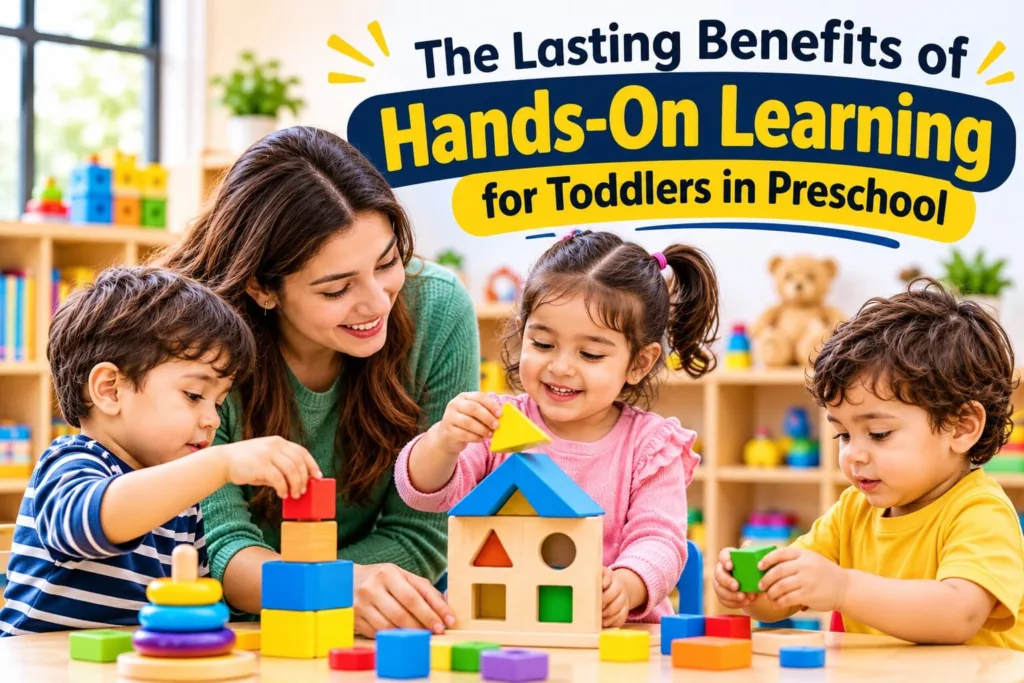
Step into any thriving early learning classroom and you will rarely see young children sitting passively in neat rows listening to lectures. Instead, you will hear the rhythmic clatter of wooden blocks tumbling onto a carpet, watch small hands plunging deep into cool sensory basins filled with water and river stones, and observe focused faces testing how two gears interlock. The toddler stage is a window of rapid physical and neurological growth where intellectual discovery is tied directly to tactile physical movement. For parents examining how early environments shape long-term cognitive milestones, understanding the power of hands on learning for toddlers provides an invaluable guide.
At Surrey City Childcare, situated at 12250 100 Ave, Surrey, BC V3V 2X1, Canada, our dedicated educators structure an intentional infant toddler program that honors this developmental stage. As a reliable, affordable, and professional education provider for toddlers and growing families across Surrey and neighbouring areas, our philosophy treats tangible discovery not as an occasional activity, but as the very foundation of lifelong intelligence, emotional resilience, and executive function.
The Brain Science Behind Tactile Discovery
To appreciate why toddlers learn by touching, squeezing, stacking, and pulling, it helps to look inside the developing brain. During the first five years of life, the human brain forms more than one million new neural connections every single second. These synaptic pathways are not built through passive observation or digital screens; they are forged through multi-sensory feedback loops.
When a young child interacts with their surroundings, sensory inputs flood the central nervous system:
- Proprioceptive feedback from muscle resistance as they lift a heavy wooden block.
- Tactile sensory data as their fingertips register the difference between smooth polished birch, gritty sand, and cool liquid watercolour.
- Visual-spatial calculations as their eyes track where an object sits in three-dimensional space relative to their own body.
This multi-sensory immersion is known as embodied cognition. Simply put, young children do not think with their minds alone; they think with their whole bodies. When a child manipulates an object directly, the brain encodes that memory across multiple sensory cortexes simultaneously. This creates durable cognitive connections that far outlast any information absorbed through two-dimensional pictures or verbal explanations.
Moving Away from Passive Instruction to Play-Based Wonder
In conventional schooling models, learning has historically been treated as an exercise in information delivery: a teacher speaks, and a student listens. In the realm of early childhood development, this method completely misaligns with how a toddler’s nervous system operates.
Implementing play based early childhood education shifts the child from a passive recipient of facts into an active investigator. When an educator tells a toddler, “Heavy things sink and light things float,” the words remain abstract and disconnected from their lived reality. But when that same child drops a dense pebble into a water basin and watches it plunge to the bottom, then places a dry pinecone on the surface and watches it bob, the physical principles of density and buoyancy become visceral realities.
By encouraging tactile learning activities for preschoolers, educators empower children to formulate their own hypotheses, test their predictions in real time, and adjust their conclusions when an experiment yields an unexpected result. This iterative process is the scientific method in its purest, most authentic form.
Accelerating Fine Motor Skill Development Through Physical Play
Long before a child is ready to hold a pencil, write their name, or cut cleanly along a printed line, they must develop the intricate musculature and neurological control of their fingers, hands, wrists, and forearms.
Promoting fine motor skill development cannot be rushed with repetitive pencil worksheets. It occurs naturally and joyfully when children are invited to manipulate diverse physical textures:
1. Pincer Grasp Mastery
When children pick up small buttons, sort dried beans with child-safe tweezers, or thread large wooden beads onto thick yarn, they strengthen the pincer grasp between the index finger and thumb. This exact finger opposition is what eventually enables a child to write comfortably without hand fatigue or cramping.
2. Bilateral Coordination
Tearing paper for sensory collages, rolling modelling clay with two hands, or stabilizing a plastic mixing bowl with one hand while stirring with the other trains both hemispheres of the brain to communicate seamlessly across the midline of the body.
3. Hand-Eye Coordination and Spatial Awareness
Stacking balancing stones, inserting pegs into board grids, and slotting varying shapes into wooden puzzles train the eyes and hands to operate as a coordinated team, directly laying the groundwork for reading tracking and spatial math concepts.
The Therapeutic Power of Sensory Exploration in Daycare
Modern life often exposes young children to overstimulating digital noise, artificial lighting, and structured schedules. In contrast, dedicated sensory exploration in daycare serves as an essential calming mechanism for a toddler’s developing nervous system.
Sensory bins filled with water, dried lentils, clean river pebbles, or natural dough provide deep tactile feedback that promotes self-regulation. When an overstimulated toddler plunges their hands into warm water or smooth sand, the repetitive, rhythmic motion activates the parasympathetic nervous system, lowering cortisol levels and restoring emotional balance.
Furthermore, sensory play encourages non-verbal and emerging verbal children to explore rich descriptive vocabularies. As educators play alongside toddlers, they introduce evocative language:
- “Notice how squishy and cool this clay feels between your fingers?”
- “This burlap is rough, but look how slick and slippery the silk ribbon is.”
- “Can you hear the crunchy sound the dry leaves make when we crumple them together?”
This natural linguistic scaffolding connects physical sensations to precise vocabulary, accelerating language acquisition in a meaningful, contextual setting.
Cultivating Divergent Thinking, Problem-Solving, and Resilience
One of the greatest hazards of overly structured early instruction is the fear of failure it inadvertently instills. When an activity has a single, rigid “correct” outcome, a child quickly learns to look to an adult for validation, growing hesitant to take creative risks.
Hands-on learning with open-ended materials completely removes this anxiety. Consider a collection of simple loose parts: wooden spools, cardboard cylinders, smooth stones, and felt scraps. Unlike a commercial toy with a single predetermined function, loose parts have infinite possibilities:
- Today, a cardboard cylinder is a telescope to spot imaginary birds.
- Tomorrow, that same cylinder becomes a water chute or a load-bearing column for an elaborate block castle.
- The next day, it is a rolling pin to smooth out soft dough.
When children encounter an open-ended challenge—such as a tall block tower that wobbles and collapses—they do not fail; they collect immediate, objective feedback from gravity. An attentive early educator does not step in to rebuild the tower for them. Instead, the educator offers gentle coaching: “That was quite a crash! It looked like the small block on the bottom had trouble holding the three big blocks on top. What could we try using for a wider base?”
Through this guided physical reflection, toddlers learn that setbacks are merely invitations to test a new design, developing emotional resilience and creative problem-solving skills that serve them throughout life.
Why Hands-On Early Learning Matters for Kindergarten Success
As parents look forward to the milestone of surrey kindergarten registration, many wonder how to best prepare their child for the academic expectations of elementary school. A common misconception is that early academic success requires memorizing flashcards or completing early literacy worksheets.
In reality, kindergarten educators across the province consistently emphasize that true readiness is not measured by rote memorization. The children who thrive in kindergarten are those who possess:
- Strong self-regulation and executive function skills.
- The physical hand strength and stamina to manipulate learning tools.
- Curious minds that ask thoughtful questions when faced with new problems.
- The social confidence to collaborate with peers on shared tasks.
A hands-on, inquiry-based foundation builds precisely these competencies. When a child has spent their toddler and preschool years exploring how materials behave, negotiating tools with classmates, and focusing deeply on complex sensory projects, they enter elementary school with a resilient foundation and an appetite for discovery.
Navigating Quality Early Childhood Choices Across Surrey
Selecting the right early childhood learning environment is an important decision for local families. Whether you are actively searching for a high-standard preschool surrey program, looking into an accredited licensed toddler daycare surrey centre, or evaluating your options for an intentional day care in surrey bc, examining how a centre prioritizes real-world sensory materials over passive routines provides immediate insight into their educational values.
Parents frequently spend hours typing daycare near me or pre kindergarten near me into online search engines, hoping to balance high pedagogical standards with practical commuter accessibility. Choosing an accredited, community-focused provider that delivers comprehensive surrey childcare and embraces the British Columbia Early Learning Framework ensures that your toddler’s natural curiosity will be met with respect, warmth, and professional developmental guidance every single day.
Frequently Asked Questions
How do hands-on learning activities differ between an infant and a preschooler?
Hands-on discovery evolves alongside motor and cognitive capabilities. For infants, hands-on learning centers around basic tactile sensory exploration, such as grasping textured fabric rings, exploring soft rattles, and tummy-time floor exploration. For toddlers and preschoolers, it expands into multi-step investigative play, such as building balance ramps, mixing primary colours, and cooperative loose-parts engineering.
What areas in Surrey does Surrey City Childcare accommodate for daily enrollment?
Our licensed facility is located on 100 Avenue in North Surrey, offering accessible care for working families residing in or commuting through City Centre, Whalley, Guildford, Fleetwood, and surrounding commuter routes across the Fraser Valley.
How quickly does your administrative team respond to tour bookings and program inquiries?
We recognize that securing trusted early learning is a time-sensitive milestone for families. Our administrative office reviews all website contact requests, tour applications, and phone messages promptly, maintaining a standard response turnaround of 24 to 48 business hours on weekdays.
Is messy, hands-on play safe for toddlers who still explore objects with their mouths?
Yes. Professional early childhood classrooms utilize taste-safe, non-toxic, and age-appropriate sensory materials for younger toddlers, such as water, clean ice, food-grade oats, gelatin, and homemade salt dough. Certified educators maintain close supervision and follow strict licensing sanitation protocols to ensure sensory exploration is entirely safe.
How can parents recreate meaningful hands-on learning at home without buying expensive toys?
Parents can create rich tactile learning opportunities using simple household items. Fill a plastic dish bin with water and kitchen measuring spoons, offer child-safe tongs to transfer ice cubes between muffin tins, provide dry pasta for sorting, or take outdoor nature walks to collect leaves, twigs, and smooth stones.
Cultivating Curious, Confident Thinkers for Tomorrow
Early childhood is a brief, precious window of intense wonder and physical discovery. By prioritizing hands on learning for toddlers, we honor the natural way young minds make sense of the world around them. When we provide toddlers with the freedom to touch, build, pour, test, and imagine, we help them construct not only a deep understanding of physical sciences and fine motor control, but an unshakeable sense of their own competence and creative agency.
At Surrey City Childcare, located at 12250 100 Ave, Surrey, BC V3V 2X1, Canada, our passionate early childhood educators are dedicated to creating a secure, licensed, and affordable early childhood home for families across North Surrey. Through our specialized infant toddler program, we invite young learners to explore, discover, and thrive in an environment designed around hands-on curiosity. If you are exploring educational early learning options or seeking a supportive community for your child, reach out to our team today to arrange a personalized facility visit and experience our play-based learning environment firsthand.