
Summary
- Exploring process art vs craft projects in daycare highlights why the journey of creative exploration provides deeper cognitive benefits than chasing a picture-perfect end product.
- Process-driven creative experiences cultivate self-confidence, emotional regulation, and decision-making independence in toddlers.
- Traditional product crafts frequently limit imagination by requiring young children to follow rigid, adult-driven templates.
- Open-ended sensory activities strengthen fine motor skills, bilateral coordination, and spatial awareness naturally through tactile experimentation.
- Surrey City Childcare embraces child-led, multi-sensory art exploration across its early childhood programs to nurture curious, capable, and confident young thinkers.
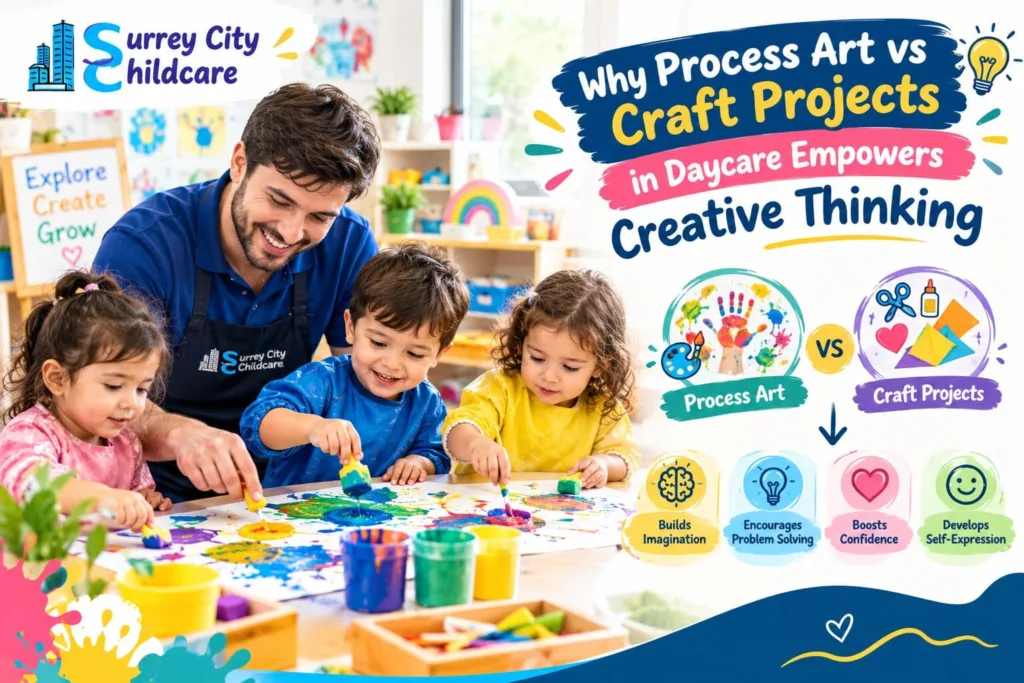
When parents pick up their toddler from daycare, one of the most delightful daily moments is peeking into their cubby to see what creative treasures they produced during the day. Sometimes you discover a carefully assembled paper-plate ladybug with two pre-cut black antennae glued exactly in place. Other times, you find a thick sheet of heavy cardstock covered in broad strokes of blended turquoise, textured splatters of yellow tempera, and crinkled tissue paper pressed into the corners. While both pieces are heartwarming keepsakes, examining process art vs craft projects in daycare reveals two entirely different developmental philosophies.
At Surrey City Childcare, situated at 12250 100 Ave, Surrey, BC V3V 2X1, Canada, our certified early childhood educators design enriching early learning programs where children are encouraged to question, experiment, and express themselves freely. As a reliable, affordable, and professional education provider for toddlers and growing families across Surrey and surrounding communities, our team views early artistic expression as a gateway to critical thinking, emotional resilience, and lifelong cognitive confidence.
Looking for a licensed early learning centre that nurtures your child’s natural imagination? Get in touch with our friendly Surrey City Childcare educators today to reserve a tour.
Deconstructing the Core Difference: Process Versus Product
To understand why pedagogical experts place such an immense emphasis on child-led creativity, it helps to examine what actually happens during an art session.
Traditional craft projects are product-oriented. In a product-focused craft, the educator or adult has a predetermined end goal in mind. The teacher cuts out twenty identical green shamrocks, provides twenty pairs of googly eyes, and instructs each child where to dab the glue stick. If a child decides they want to place both googly eyes on the side of the plate or paint the shamrock orange, an adult might instinctively redirect them: “No, sweetheart, the eyes go here in the middle.” While this exercise trains listening skills and multi-step compliance, it offers very little room for original thought. The finished pieces lining the hallway look uniform, but the creative voice of each child remains quiet.
In direct contrast, process art places one hundred percent of the focus on the experience of creation rather than the final outcome. There is no sample model sitting on the teacher’s desk for the children to copy. There are no right or wrong ways to interact with the materials. If a child wants to use a kitchen dish scrubber to stamp navy paint across the canvas, mix five shades together until they create rich earth-toned brown, or spend ten minutes running their fingers through liquid starch, their choices are welcomed and celebrated. Process art honors the child’s curiosity, allowing their inner world to guide the brush, the clay, or the paper scrap.
The Cognitive Architecture of Creative Thinking
Toddlers and preschoolers do not learn through passive lectures; their brains develop through active, multi-sensory experimentation. When a child engages in open-ended creative exploration, their brain is running dozens of tiny scientific experiments simultaneously.
Consider what occurs when a toddler decides to blend blue paint with yellow paint on an easel. In a rigid craft project, the colours are premixed and controlled. In open-ended exploration, the child discovers color theory firsthand. They watch the colours swirl together, notice the transformation into vibrant emerald green, and realize that their own physical actions produced that visible change. This fosters a profound sense of self-efficacy and early scientific reasoning.
1. Fostering Divergent Thinking
Divergent thinking is the cognitive ability to generate creative solutions by exploring many possible possibilities. Modern elementary schools and future workplace environments do not simply reward individuals who memorize rigid routines; they value individuals who can look at an open-ended problem and invent novel solutions. By encouraging process art for toddlers, educators help young learners understand that there is never just one single way to solve a challenge or express a thought.
2. Encouraging Healthy Risk-Taking and Resilience
When an art project has a “correct” way to look, children quickly develop performance anxiety. They look at the educator’s neat example, look down at their own unsteady paper cutout, and say defeatedly, “I can’t do it. You do it for me.” This early hesitation can morph into a fear of making mistakes.
Process art completely eliminates the fear of failure. Because there is no template, a child cannot get it “wrong.” A spilled drop of paint becomes an interesting blot; a tear in the paper becomes an opportunity to patch or reshape the design. Children learn to adapt, pivot, and trust their creative instincts.
Fine Motor Mastery and Sensory Integration
Art is an inherently physical undertaking. Long before a child holds a primary school pencil to print letters or write sentences, they must build the foundational musculature of their fingers, wrists, and shoulders. Promoting fine motor development in daycare happens far more organically through tactile exploration than through handwriting worksheets.
Hand Strength and Bilateral Coordination
When children participate in unstructured creative sessions, they manipulate materials with varying textures, weights, and resistances:
- Tearing and Crumpling Paper: Tearing heavy cardstock or tissue paper requires bilateral coordination—using both hands simultaneously in opposite motions. This strengthens the intrinsic hand muscles that govern pencil grip.
- Squeezing Droppers and Pipettes: Using liquid watercolours with eye droppers or turkey basters builds grip strength and trains the pincer grasp between the thumb and forefinger.
- Manipulating Clay and Dough: Pounding, rolling, pinching, and sculpting real clay provides proprioceptive sensory feedback while increasing wrist stability and finger dexterity.
- Scissor Experiments: In an open-ended setup, children cut random snips into construction paper, cardboard strips, or rolled dough without the stress of trying to follow a precise printed circle.
This rich physical engagement also benefits the sensory nervous system. Young children who might otherwise feel overwhelmed by unpredictable classroom textures often find calm through the repetitive, rhythmic movements of finger painting, chalk rubbing, or water play.
Practical Examples of Open-Ended Art for Preschoolers
Educators and parents do not need elaborate, expensive equipment to facilitate meaningful creative sessions. The most captivating open ended art for preschoolers often utilizes everyday household goods and natural elements found outdoors in our local Pacific Northwest communities.
1. Nature-Infused Botanical Prints
Take children on an outdoor nature walk through a local park or yard to collect fallen evergreen sprigs, maple leaves, ferns, smooth stones, and textured bark. Back at the art table, set out shallow trays of washable paint and heavy drawing paper. Children can dip leaves into paint to press detailed vein patterns, use evergreen sprigs like flexible paintbrushes, or press smooth stones into slabs of clay to observe natural geometric impressions.
2. Gravity and Movement Painting
Tape large sheets of butcher paper to an outdoor fence or inside a large cardboard box. Provide children with plastic squeeze bottles, small spray bottles filled with diluted food colouring, or ramps where paint-dipped marbles can roll freely. As children tip, squeeze, and tilt the surface, they explore fluid momentum, gravity, and spatial mechanics while producing striking abstract art.
3. Recycled Loose-Parts Sculpture
Provide an array of cardboard tubes, egg cartons, wooden spools, fabric ribbons, washed bottle caps, and masking tape. Rather than asking children to build a specific animal, ask open-ended questions: “What kind of world or machine can you assemble using these shapes?” Children will engineer elaborate towers, imaginative vehicles, and abstract sculptures, learning the fundamentals of structural balance and three-dimensional form.
Cultivating Emotional Literacy and Language Expansion
Toddlers frequently experience deep, complex emotions that far exceed their developing verbal vocabularies. When words fail them, non-verbal expression steps into the gap. Art serves as a vital emotional outlet, offering children a safe container to externalize joy, frustration, anxiety, or excitement.
In a thoughtful city preschool setting, educators use art sessions to facilitate rich dialogic conversations. Instead of offering generic praise like “Good job, that is so pretty,” attentive teachers use observational, open-ended language:
- “I notice you used heavy, dark strokes at the top of your page and light dots at the bottom. What was your hand feeling when you made those?”
- “Look at how the blue and red merged right here in the center. Tell me about this part of your work.”
- “You worked with that clay for twenty minutes trying to get it to stand upright. How did you figure out how to balance it?”
This conversational style teaches children rich descriptive vocabulary, validates their internal decision-making process, and encourages them to reflect on their own thoughts rather than looking outward for constant adult approval.
Evaluating Early Learning Environments in British Columbia
When local parents begin the process of researching an enriching surrey childcare provider or evaluating a daycare in surrey bc, examining the classroom walls provides an immediate window into the educators’ philosophy.
If every piece of artwork displayed on the classroom wall is identical—twenty paper penguins with the exact same orange beak placed at the exact same forty-five-degree angle—it usually signifies an environment that prioritizes adult control and aesthetic conformity over developmental inquiry.
On the other hand, when you tour an accredited licensed toddler daycare surrey facility and observe walls adorned with diverse paintings, textured collages, and collaborative group murals where no two creations resemble one another, you are looking at an environment that respects the individuality of the child.
Whether you are seeking a supportive infant and toddler daycare surrey program or a dynamic pre-kindergarten community, choosing an educational space that champions early childhood art activities rooted in process over product ensures that your little one will be nurtured by educators who value autonomy, original thinking, and genuine self-expression.
Frequently Asked Questions
Why does process art sometimes look like random scribbles or a single messy brown smear?
Young children explore art kinesthetically and sensorially rather than visually. When a toddler blends every colour on their palette until it turns brown, they are not trying to paint a realistic portrait; they are investigating cause-and-effect and the physical experience of mixing liquid textures. The cognitive value lies in the discovery, not in creating a decorative picture for adult display.
What specific neighbourhoods and commuter corridors does Surrey City Childcare serve?
Conveniently located on 100 Avenue in North Surrey, our licensed facility serves families living and working throughout City Centre, Whalley, Guildford, Fleetwood, and surrounding commuter routes across the Fraser Valley and Greater Vancouver regions.
How quickly does your administrative team respond to child enrollment and tour inquiries?
We recognize that securing quality childcare is an urgent milestone for working families. Our administrative team typically reviews and replies to all online tour bookings, phone calls, and program inquiries within 24 to 48 business hours on regular weekdays.
Are craft projects completely harmful, or do they still have a place in preschool?
Craft projects are not harmful, and they can be enjoyable when used occasionally to practice listening to step-by-step instructions or using specific tools like hole punches and safety scissors. However, crafts should never replace open-ended creative exploration. An intentional curriculum prioritizes process-driven activities as the primary engine for cognitive and creative growth.
What should parents do with all the abstract process artwork coming home from daycare?
Celebrate the effort rather than judging the image. Ask your child to share the story behind their work, hang a rotating gallery on the refrigerator using wooden clothespins, or snap digital photos of their favourite pieces to preserve their developmental milestones without cluttering your living space.
Empowering Tomorrow’s Innovators Through Child-Led Discovery
Every stroke of a paintbrush, every pinch of soft clay, and every drop of swirling colour represents a child actively constructing their understanding of the world. Understanding the developmental differences in process art vs craft projects in daycare reminds us that early learning is never about conformity or producing polished, picture-perfect crafts to satisfy adult eyes. By giving toddlers the freedom to explore materials without boundaries, we nurture resilient innovators who are unafraid of open-ended problems, eager to experiment, and proud of their own unique voices.
At Surrey City Childcare, located at 12250 100 Ave, Surrey, BC V3V 2X1, Canada, we are dedicated to providing a nurturing, licensed, and affordable early childhood experience for families across North Surrey and beyond. Our collaborative team of educators weaves meaningful, play-centered sensory learning into our specialized early learning programs every day. If you are searching for a high-quality day care in surrey or comparing options for a trustworthy surrey daycare near me, connect with our welcoming staff today to arrange an in-person facility visit and discover how we help your child’s creative potential thrive.