
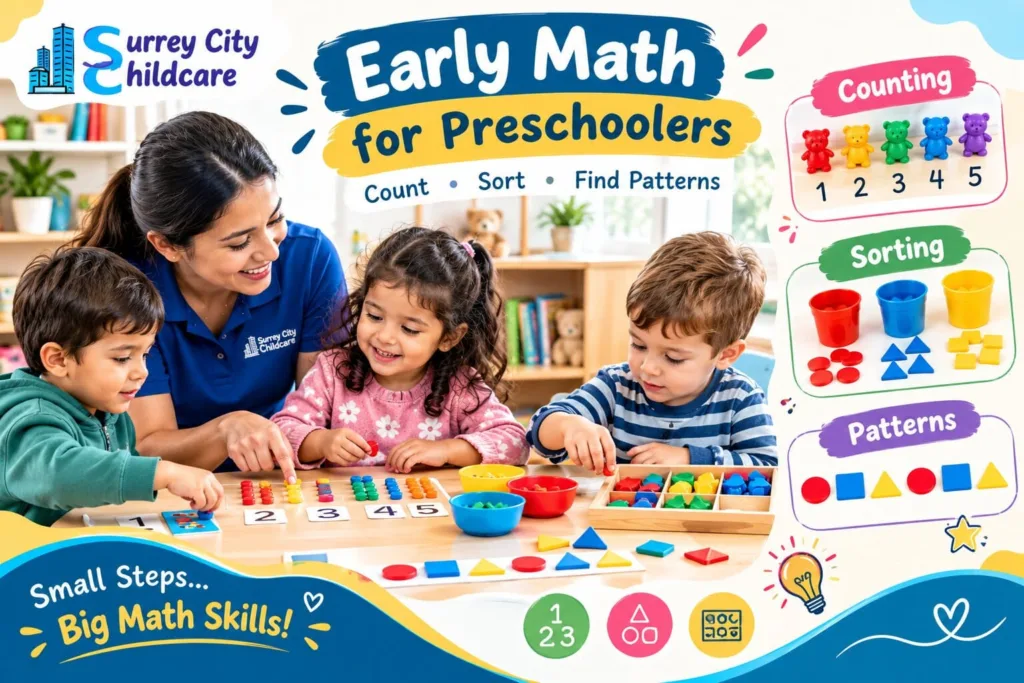
Summary
- Nurturing early math for preschoolers focuses on hands-on discovery, spatial reasoning, and play rather than flashcards or repetitive worksheets.
- Building early number sense enables children to understand quantities, compare amounts, and recognize numerical relationships naturally in daily life.
- Everyday routines—such as setting the dinner table, sorting laundry, or collecting outdoor treasures—double as powerful learning opportunities.
- Interactive sorting and patterning exercises strengthen executive functioning, logical reasoning, and early problem-solving capabilities.
- Surrey City Childcare integrates multi-sensory math exploration into daily classroom experiences to cultivate curious, confident, and school-ready learners.
When parents hear the word mathematics, their minds frequently travel back to formal equations, timed tests, and blackboards full of numbers. However, when we talk about early math for preschoolers, the reality looks entirely different. Long before children write down numerals or memorize addition facts, they explore mathematical principles through the physical world around them.
At Surrey City Childcare, situated at 12250 100 Ave, Surrey, BC V3V 2X1, Canada, our early childhood educators see mathematics as an active language of discovery. Through our specialized infant toddler program and preschool curriculum, our team provides families across Surrey with a reliable, affordable, and professional foundation where little learners discover that numeracy is practical, intuitive, and joyful.
From sorting loose parts to counting outdoor treasures, our classrooms make math come alive. Get in touch with our friendly Surrey daycare team today to find the right program for your child..!

Redefining Mathematics in the Early Years
Early numeracy is fundamentally about recognizing how objects relate to one another in physical space, understanding quantities, and predicting what comes next. Toddlers and young children are natural pattern-seekers. They notice that one block tower stands taller than another, they observe that one bowl has more blueberries than their sibling’s, and they spot the rhythm of footsteps during an outdoor walk.
Instead of introducing formal academic pressure, early childhood education focuses on concrete experiences. When children physically manipulate objects, their hands send vital neurological signals to the brain that form the architecture for abstract thinking later on. Mathematical confidence starts with three core developmental pillars: counting with genuine understanding, sorting to categorize the environment, and identifying recurring patterns.
Nurturing True Number Sense Beyond Memorization
Many toddlers can recite numbers from one to ten from memory, much like reciting the lyrics of a nursery song. While this verbal sequence is an impressive memory milestone, it does not necessarily mean the child grasps what those numbers signify.
Developing genuine number sense means a child understands that the spoken word “three” represents a distinct, unchanging quantity of items, regardless of whether those items are large apples or tiny buttons.
1. One-to-One Correspondence
The first vital concept in counting is one-to-one correspondence—the ability to match one physical object to one corresponding number word. Toddlers often count quickly, pointing to three objects while reciting five numbers. Certified educators guide children to touch or move each object as they say the word aloud: “One block (slide), two blocks (slide), three blocks (slide).” This kinesthetic feedback ensures that the child links the sound to the object.
2. Subitizing: Recognizing Amounts at a Glance
Subitizing is the ability to instantly perceive the quantity of a small group of items without counting them individually. For instance, when you roll a die and see three dots, you do not count “one, two, three.” You simply see “three.” Playing simple dice games, recognizing dot patterns on dominos, or holding up fingers for quick recognition games strengthens this skill.
3. Engaging Counting Games for Preschoolers You Can Try Anywhere
You do not need specialized materials to practice counting. The best counting games for preschoolers happen naturally throughout your daily schedule:
- The Grocery Cart Helper: While walking down the grocery aisle, invite your preschooler to count out five red apples or three yellow bell peppers into your produce bag.
- Staircase Steps: Count each step out loud as you climb up and down the stairs at home or at the community centre.
- Toy Parking Lot: Draw numbered parking spaces on a cardboard box using a marker and ask your child to park one toy car in each numbered stall.
The Power of Sorting: Classifying the World Around Us
Before children compare numbers, they must learn to analyze attributes such as size, colour, weight, texture, and shape. Sorting is the brain’s way of organizing sensory input, building early logic, and establishing foundational set theory.
When children sort, they are engaged in visual discrimination and critical analysis. They have to inspect an object, identify its unique characteristics, and make a conscious decision about where it belongs based on a specific rule.
Simple and Engaging Sorting Activities for Preschoolers
Incorporating sorting activities for preschoolers into your home life transforms everyday household chores into fun, hands-on learning moments:
- The Mismatched Sock Match: When folding clean laundry, dump a basket of clean socks on the carpet. Ask your child to group them by colour, match matching pairs, or separate grown-up socks from toddler socks.
- Nature Scavenger Sorting: During an afternoon visit to a local park or trail, collect leaves, rocks, twigs, and pinecones. Once you sit down on a park bench, invite your child to sort their treasures by texture (rough versus smooth), size (big versus tiny), or category (leaves versus stones).
- Utensil Drawer Organizing: Unloading the dishwasher provides an excellent sorting challenge. Let your toddler separate teaspoons from tablespoons or sort dull butter knives from forks into the drawer organizer.
- Colour-Coded Toy Clean-Up: Turn clean-up time into an engaging sorting activity by placing coloured pieces of construction paper on the floor. Challenge your child to put all blue toys on the blue sheet and all green toys on the green sheet.
As children become proficient at single-attribute sorting (such as sorting purely by colour), challenge them with multi-attribute sorting: “Can you find the buttons that are both blue AND large?” This gentle progression sharpens cognitive flexibility and analytical reasoning.
Rhythm and Logic: Exploring Patterns in Daily Life
Patterns form the structural rhythm of the universe, from musical melodies and seasonal weather shifts to digital computer code. A pattern is any predictable sequence that repeats according to a clear rule.
Learning to identify, duplicate, and extend patterns teaches young minds to predict outcomes and draw logical conclusions. When a child grasps how patterns work, they develop the mental framework needed to understand time schedules, grammatical structures in reading, and advanced arithmetic operations like multiplication.
Progression of Patterning Skills
Preschoolers generally progress through distinct stages when learning patterns:
- Recognizing: Spotting an existing pattern in their environment (such as stripes on a shirt).
- Duplicating: Copying a pattern that an adult or educator has created.
- Extending: Continuing an established pattern forward: “Red, blue, red, blue… what comes next?”
- Creating: Originating their own repeating sequences using open-ended materials.
Interactive Pattern Games for Kids
You can introduce entertaining pattern games for kids almost anywhere using readily available household items or body movements:
- Movement and Sound Patterns: Step away from objects entirely and create kinetic patterns with your bodies. Try clapping, stomping, clapping, stomping (an AB pattern). Advance to clap, clap, jump, clap, clap, jump (an AAB pattern). This pairs auditory processing with whole-body motor control.
- Snack Time Sequences: Use afternoon snacks to explore delicious patterns. Line up pretzel, grape, pretzel, grape on a plate, or build fruit skewers using alternating melon cubes and strawberries.
- Bead and Pasta Threading: Stringing dry pasta tubes and colourful wooden beads along a piece of yarn exercises fine motor muscles while challenging your child to maintain an ABC pattern (yellow bead, blue bead, pasta tube).
- Nature Patterns on Sidewalks: Using pine needles and pebbles collected outside, create a repeating line along the edge of the sidewalk and ask your child to find the next item needed to keep the pattern going.
Weaving Math at Home Into Everyday Conversations
Parents frequently ask how to fit structured learning into busy family lives. The secret is that you do not need dedicated study desks or formal study blocks. Integrating math at home simply means talking about the physical world using descriptive, quantitative language.
Try embedding these effortless conversational math habits into your routines:
- Use Spatial Words: Intentionally use words like above, below, behind, between, next to, under, and through when talking with your child during play.
- Compare Quantities and Sizes: Ask questions that invite comparison: “Which cup holds more water?” “Is this blanket longer or shorter than your bed?” “Who is carrying the heavier bag?”
- Count Everyday Moments: Count together while waiting at a pedestrian crosswalk, count the scoops of oatmeal poured into the breakfast pot, or count how many red cars pass by while running errands.
- Celebrate Mistakes as Discoveries: If your preschooler counts five objects and says there are six, avoid sharp corrections. Instead, recount alongside them gently: “Let’s touch each one together and check!” Keeping math lighthearted and exploratory prevents early math anxiety before it begins.
What to Look for in a Quality Early Childhood Math Environment
When researching local options for an enriching surrey daycare or comparing educational philosophies at a preschool in Surrey BC, pay close attention to how early mathematics is presented inside the classrooms.
A high-performing early learning centre will not subject toddlers to silent desk work or paper worksheets. Instead, look for classrooms filled with open-ended manipulatives such as wooden unit blocks, measuring tapes, balance scales, sand and water sensory tables, puzzles, and loose parts.
Dedicated educators should be observed getting down on the floor, asking open-ended questions, and narrating play: “I notice that you built a tower with three square blocks and one triangle block on top. How tall do you think we can make it before it wobbles?”
Choosing an accredited, high-quality daycare in surrey ensures that your toddler receives consistent encouragement from knowledgeable early childhood educators who view every playful interaction as a stepping stone toward cognitive excellence.
Frequently Asked Questions
How can I tell if my three-year-old understands counting or is just memorizing numbers?
Memorization is purely verbal; a child can say numbers in order without looking at anything. Genuine counting understanding is demonstrated through one-to-one correspondence. If you place four crackers on a plate and your child points to each cracker individually while saying “one, two, three, four” and recognizes that four is the total amount, they are demonstrating true counting comprehension rather than rote recitation.
What areas in Surrey does Surrey City Childcare serve?
Our licensed early learning facility is centrally located on 100 Avenue in Surrey. We welcome families living and working throughout North Surrey, Whalley, City Centre, Guildford, Fleetwood, and surrounding commuter routes across the Fraser Valley and Greater Vancouver regions.
How quickly does your administrative team reply to tour and enrollment requests?
We know that finding reliable childcare is a time-sensitive priority for families. Our administrative staff reviews and responds to all website contact submissions, phone inquiries, and tour bookings within twenty-four to forty-eight business hours on regular weekdays.
What kinds of preschool math activities are best for energetic children who cannot sit still?
For active children, whole-body math is ideal. Incorporate gross-motor movement games like hopscotch number grids, tossing beanbags into numbered buckets, outdoor scavenger hunts where they search for specific quantities of sticks, and musical rhythm clapping. Physical movement enhances focus and helps energetic children absorb mathematical concepts naturally.
Does Surrey City Childcare offer programs for infants as well as preschoolers?
Yes. Surrey City Childcare provides comprehensive care starting from infancy through preschool age. Our dedicated infant toddler program provides responsive, relationship-based nurturing for our youngest children, while our preschool curriculum delivers structured, play-based learning that prepares older toddlers for kindergarten readiness.
Building Confident Young Thinkers for the Future
At Surrey City Childcare, located at 12250 100 Ave, Surrey, BC V3V 2X1, Canada, our passionate team of educators is committed to providing licensed, affordable, and high-quality early childhood education. Whether through our gentle infant toddler program or our dynamic preschool classrooms, our staff ensures that children receive rich, multi-sensory experiences that inspire a lifelong love for discovery. If you have been searching for an exceptional surrey daycare near me or evaluating options for reputable childcare near me, contact our team today to schedule an in-person tour and see how we help your child’s early potential flourish.