
Summary
- Implementing responsive calming strategies for toddlers helps children navigate daily daycare transitions without feeling overwhelmed or anxious.
- Toddler meltdowns during routine shifts are developmental expressions of an immature nervous system rather than willful disobedience.
- Sensory grounding techniques, predictable visual schedules, and empathetic co-regulation form the cornerstone of emotional resilience in early childhood.
- Intentional transition cues, such as countdown songs and comfort items, bridge the emotional gap between home and the classroom environment.
- Surrey City Childcare integrates gentle, evidence-based behavioral guidance into daily classroom routines to support balanced growth.
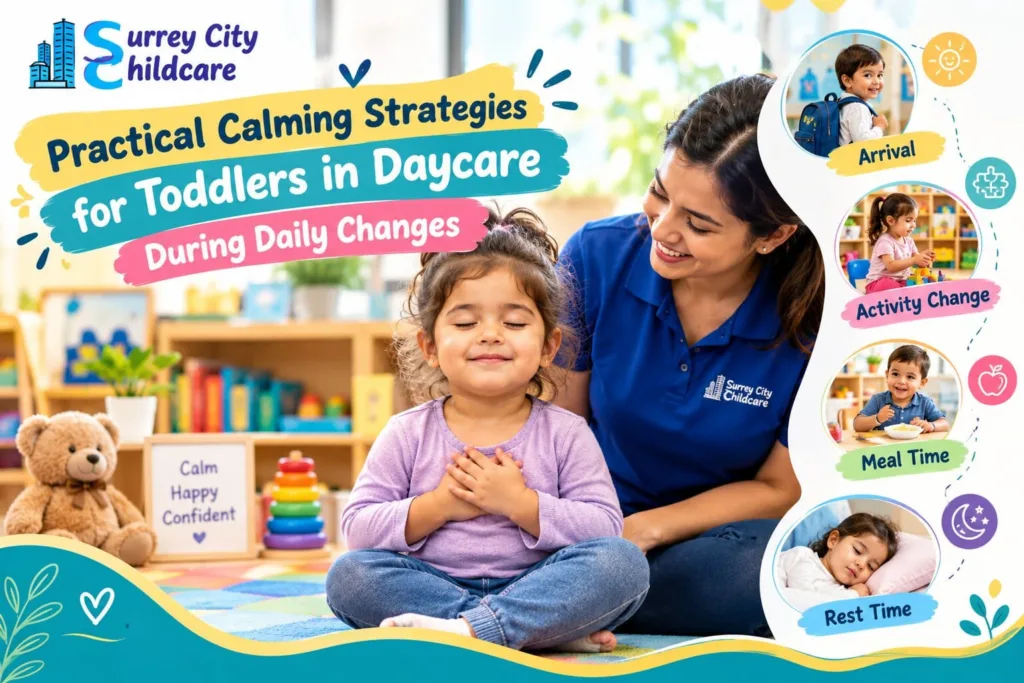
For a young child, a single day at daycare involves a continuous series of major shifts. Moving from home to the classroom, shifting from high-energy outdoor exploration to quiet lunch routines, and settling down onto a rest mat all demand significant mental and emotional effort. At Surrey City Childcare, located at 12250 100 Ave, Surrey, BC V3V 2X1, Canada, our educators know that teaching reliable calming strategies for toddlers is essential for creating a reassuring, secure early learning environment.
Through our dedicated infant toddler program, our team supports families across Surrey by using practical co-regulation techniques that turn potentially stressful daily transitions into moments of connection and confidence.
Every big emotion deserves a calm guide. Chat with us on WhatsApp to discover how Surrey City Childcare fosters emotional resilience and positive behavior in the classroom..!

The Developing Toddler Brain: Why Daily Changes Trigger Big Feelin
To understand why a toddler might collapse into tears when it is time to put away wooden blocks, parents must look at neurological development. Between twelve months and three years of age, the prefrontal cortex—the part of the brain responsible for impulse control, planning, and emotional management—is still in its earliest stages of wiring.
Toddlers live entirely in the immediate moment. When an adult announces that playtime has finished, the child experiences that shift not as an orderly step in a schedule, but as a sudden, jarring disruption to their focus. Their limbic system, which controls emotional responses, can easily interpret unexpected shifts as a threat to their autonomy or safety.
When educators focus on toddler emotional regulation, the goal is never to stop an emotional reaction instantly or demand quiet compliance. Instead, the focus is on helping the child recognize what is happening in their body and offering external emotional stability until their own nervous system settles.
Redefining Toddler Behavior in Childcare Settings
It is very common for parents to worry that their child’s strong reactions during drop-off or naptime signal behavioral problems. In reality, toddler behavior in childcare reflects the natural learning curve of social-emotional development.
Crying during transitions, resisting handwashing routines, or clinging to a favourite toy are typical communication methods for a child whose verbal language cannot yet keep pace with their internal experience. When educators and parents view these behaviors through a developmental lens, our responses naturally shift from frustration to guidance.
Children do not learn to self-soothe through isolation or stern commands. They learn through co-regulation—the process where an empathetic adult lends their calm, organized nervous system to help settle a child’s disorganized emotions. Over time, consistent co-regulation becomes internal self-regulation.
Practical Strategies for Managing Daycare Transitions
Creating a calm room dynamic requires proactive structure rather than reactive corrections. Certified early childhood educators use specific techniques to make daily shifts predictable and comfortable for young children.
1. Visual Schedules and Tangible Cues
Abstract time concepts like “five more minutes” mean very little to a two-year-old. Visual schedules using real photographs of daily activities give toddlers a concrete sense of time. When children can see that outdoor play is followed by handwashing, lunch, and quiet rest, their sense of security increases. Visual sand timers or soft chimes also provide physical cues that a change is approaching, giving the toddler’s brain time to prepare for the end of an activity.
2. Transition Songs and Rhythmic Routine
Auditory markers engage the brain’s rhythm centres, lowering anxiety. Singing a consistent tidy-up song or chanting a handwashing rhythm makes routine tasks feel like an engaging game rather than an interruption. Familiar melodies trigger feelings of comfort and familiarity, signaling to children that they are safe and know what comes next.
3. Transition Objects and Continuity of Care
Carrying a small piece of home into the classroom eases the morning separation process. Whether it is a small family photo kept in their cubby or a favourite soft toy for rest time, these tangible items serve as emotional anchors. They bridge the gap between home and care, reminding the child that their family connection remains strong even while they explore their classroom.
Multi-Sensory Calming Tools for the Early Childhood Classroom
When big emotions take over, verbal reasoning is rarely effective. A child in the middle of a meltdown cannot process long explanations. Engaging the physical senses is the most direct way to bring a child back to an emotional baseline.
Early learning settings often incorporate intentional sensory calming activities into daily routines:
- Heavy Work and Proprioceptive Input: Pushing a child-sized wagon, carrying wooden blocks to a shelf, or gently crawling through a soft fabric tunnel activates the body’s proprioceptive system. This deep-muscle engagement sends calming signals to the brain, helping children feel grounded.
- Cozy Reset Corners: A quiet space filled with soft pillows, books, and muted lighting offers children a safe retreat when group energy becomes overwhelming. This is never used as a time-out space; rather, it is a comfortable place where children can sit with an educator, hold a sensory glitter bottle, or take a quiet pause.
- Deep Breathing Through Imagery: Teaching toddlers to “smell the flower and blow out the candle” gives them an easy visual for deep diaphragmatic breathing. Inhaling slowly and exhaling gently stimulates the vagus nerve, reducing heart rate and physical tension.
- Tactile Water and Dough Play: Gentle sensory play with warm water, pouring cups, or soft playdough provides soothing tactile feedback, giving restless hands a constructive, relaxing outlet.
Supporting Toddlers Through Morning Drop-Offs
The morning goodbye is often the most emotionally demanding transition of the day for both children and parents. Establishing a confident, repeatable drop-off routine is one of the most effective ways of managing daycare transitions.
Parents can establish a smooth routine by following a consistent sequence:
- Keep the Routine Predictable: Follow the same steps every morning. Place the backpack in the cubby, wash hands together, and walk over to greet the educators.
- Offer Controlled Choices: Empower your toddler with simple choices that do not affect the main plan: “Would you like to walk into the room on your own feet, or should I carry you to the door?”
- Never Sneak Away: Leaving while your child is distracted may avoid immediate tears, but it undermines trust and creates anxiety later in the day.
- Deliver a Warm, Confident Goodbye: Keep farewells loving, brief, and reassuring: “I love you, you are safe here with your teachers, and I will be back right after afternoon snack.” Hand the child directly to an educator and step away confidently, showing your child through your body language that you trust the environment.
Choosing a Supportive Early Learning Setting
When looking for dependable daycare in surrey bc, parents should observe how educators respond to children during moments of distress. A high-quality program prioritizes emotional well-being alongside developmental milestones.
During classroom tours, look for signs of a supportive environment:
- Educators who sit at eye level with children, using gentle tones and calm body language.
- Well-defined play zones that allow children to move freely without feeling crowded.
- Clear, unhurried routines that allow children sufficient time to finish tasks without being rushed.
- Open communication channels between educators and parents regarding daily routines, sleep patterns, and emotional milestones.
Finding a program that offers dedicated surrey childcare built around developmental needs ensures that your toddler receives the care, attention, and reassurance they need to thrive.
Frequently Asked Questions
How long does it usually take for a toddler to adjust to a new daycare schedule?
Most toddlers take between two to four weeks to become fully comfortable with a new daycare routine. Some children show initial excitement during the first few days, followed by brief separation sadness once they realize the routine is permanent. Consistent attendance, predictable goodbyes, and collaborative communication between educators and families help children settle into their new environment smoothly.
What makes Surrey City Childcare’s infant toddler program unique?
At Surrey City Childcare, our infant toddler program focuses on responsive, relationship-based care. Located in our accessible facility on 100 Avenue, our educators prioritize secure attachments, low caregiver-to-child ratios, and play-based environments designed to support each child’s social-emotional, cognitive, and physical growth at their own natural pace.
Which neighbourhoods are served by Surrey City Childcare?
Our licensed facility proudly supports families throughout North Surrey, Whalley, City Centre, Guildford, Fleetwood, and surrounding commuter communities across the Fraser Valley.
What is your typical response time for parent inquiries and tour bookings?
Our administrative office responds to all phone messages, website contact forms, and tour requests within twenty-four to forty-eight business hours on regular weekdays, ensuring local families receive prompt, helpful support.
What should I do if my child only experiences meltdowns after coming home from daycare?
Post-daycare meltdowns are very common and are often referred to as “restraint collapse.” Throughout the day, toddlers work hard to share toys, follow directions, and navigate a busy social environment. When they return home to their safest space and primary caregivers, they finally release that pent-up emotional energy. Offering a quiet sensory activity, a nutritious snack, and focused one-on-one cuddle time without immediate questions helps them decompress gently.
Fostering Lifelong Emotional Resilience
Learning to navigate change is a lifelong skill that begins in early childhood. When parents and educators respond to everyday disruptions with patience, predictable routines, and empathetic presence, toddlers learn that big feelings are manageable and temporary. Over time, practicing supportive calming strategies for toddlers transforms moments of uncertainty into opportunities for emotional growth, independence, and lasting self-confidence.
At Surrey City Childcare, situated at 12250 100 Ave, Surrey, BC V3V 2X1, Canada, we provide families with trusted, professional, and affordable early childhood education. As an experienced licensed toddler daycare surrey provider, our educators are passionate about creating a calm, engaging space where young children feel seen, heard, and supported every single day. If you are exploring options for an exceptional surrey daycare near me or comparing local facilities for a reliable daycare near me, contact our team today to arrange an in-person tour and see how our caring community can support your family’s early learning journey.