
Summary
- Developing phonemic awareness in preschoolers involves helping children hear, recognise, and manipulate individual spoken sounds before they ever interact with printed letters.
- Music, rhythm, and whole-body movement bypass rote drills by using active physical memory to turn abstract speech sounds into tangible concepts.
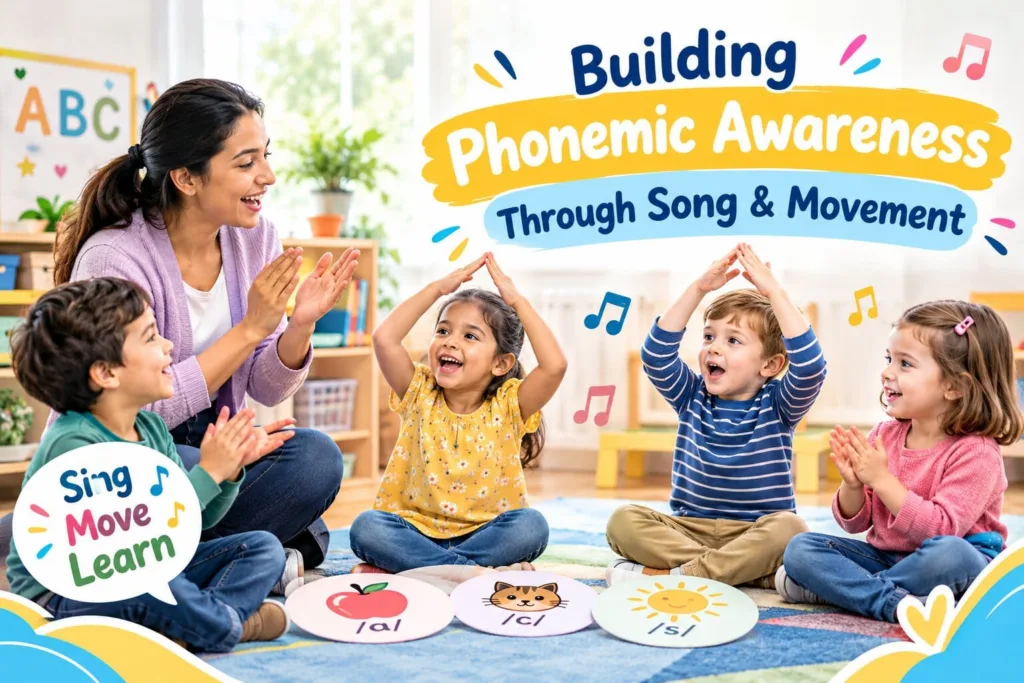
- Simple musical activities such as clapping syllables, dancing to rhyming verses, and stomping on individual sound segments build strong auditory processing pathways naturally.
- Early sound mastery serves as the primary stepping stone toward smooth elementary transitions and confident reading fluency.
- Surrey City Childcare integrates joyful song, rhythmic exploration, and multi-sensory literacy play into everyday early learning routines.
Long before a young child picks up a pencil to write the alphabet or points out letters on a printed page, their brain is busy analyzing the spoken language around them. Early childhood development proves that fluent readers are not built by drilling flashcards; they are nurtured through rich auditory play, conversation, and rhythmic discovery.
At Surrey City Childcare, situated at 12250 100 Ave, Surrey, BC V3V 2X1, Canada, our early childhood educators know that fostering phonemic awareness in preschoolers provides the real bedrock for lifelong reading confidence. By weaving musical instruments, interactive nursery rhymes, and physical movement into daily routines, our centre delivers phonemic awareness to toddlers and preschool learners across our community in an engaging, play-centred environment.
Understanding the Auditory Brain: What Phonemic Awareness Actually Means
To understand why music works so effectively, it helps to break down how children process spoken words. Many parents confuse early reading concepts, often conflating terms when comparing phonological awareness vs phonics. While they sound similar, they represent completely different stages of development.
Phonological awareness is the broad umbrella term for recognizing the units of spoken language. It includes the ability to hear whole words, clap out syllables, notice matching onset sounds, and detect rhymes.
Phonemic awareness is the narrowest, most refined component under that umbrella. It is the specific ability to hear, isolate, identify, and blend individual phonemes—the smallest distinct units of sound in a spoken word. For instance, realizing that the word cat is not just a single burst of sound, but rather composed of three separate phonemes (/k/, /æ/, and /t/), is phonemic awareness.
Phonics, by contrast, connects those auditory sounds to their corresponding printed letters on paper. A child cannot connect a letter symbol to a sound if their ear cannot distinguish the individual sound in the first place. Because phonemic awareness is strictly an auditory and oral skill, children do not need books, worksheets, or pencils to master it. You can build it in the car, on the playground, or during afternoon circle time simply through voice and physical interaction.
Why Song and Movement Accelerate Sound Processing
Young children are kinetic learners. Their physical bodies, nervous systems, and cognitive faculties are intertwined. When a toddler or preschooler sits still for extended periods listening to abstract explanations, their focus wanes. When you add rhythm, tempo, and large-muscle movements, multiple regions of the developing brain light up at the same time.
1. Rhythm Highlights Natural Speech Boundaries
Spoken language flows continuously. When adults converse, words blend together into a stream of sound. To an untrained toddler’s ear, a sentence like look at the puppy might sound like one continuous word. Rhythm introduces natural pacing. When children sing songs with steady beats, the pauses, syncopations, and musical cadences naturally isolate word boundaries and distinct sound units without feeling like an academic lesson.
2. Physical Kinesthetics Ground Abstract Concepts
A phoneme is invisible. You cannot touch the sound /b/ or pick up the sound /s/. However, when a child jumps forward every time they hear a specific target sound, or claps their hands together to blend two separate sounds into a whole word, the abstract becomes physical. This somatic engagement deepens cognitive retention through muscle memory.
3. Melodies Lower Performance Pressure
Children love singing. Singing naturally releases dopamine and lowers cortisol, creating a calm emotional state where learning flourishes. Shy or reserved children who feel intimidated by direct questioning often sing along enthusiastically in a group circle, practicing pronunciation, articulation, and auditory tracking without fear of making a mistake.
Classroom-Tested Movement Games That Build Sound Mastery
Certified early learning educators rely on active play routines to turn complex speech segmentation into fun classroom games. Families looking to practice at home can adapt these practical methods easily:
Clapping and Stomping Syllables
Before diving into tiny phonemes, children learn to feel word chunks. Syllables are the building blocks of rhythm. During group circle time, invite children to stomp their feet or beat a small hand drum to the cadence of their own names: Ju-li-an gets three drum beats; E-my gets two. Once children feel comfortable breaking whole words into rhythmic beats, their ears become tuned to recognizing even smaller sound pieces.
Rhyme Detection Through Freeze Dance
Rhyming demonstrates that words share sound families. Incorporating rhyming games for kindergarten readiness through dance makes auditory recognition fun. Put on energetic music and invite children to dance freely around the room. When the music pauses, call out two words, such as bat and hat. If the words rhyme, the children freeze in a silly pose. If they do not rhyme (like bat and cup), the children drop gently to the floor. This requires children to hold words in their working memory and evaluate their ending sounds quickly.
Hopscotch Sound Segmentation
As preschoolers advance, introduce sound segmentation activities for kids using physical movement grids. Draw three chalk squares on an outdoor patio or lay three colourful foam tiles on the floor. Give the child a simple three-sound word, such as sun. Have them jump forward into the first square while making the /s/ sound, hop into the second square for the short /ʌ/ sound, and leap into the third square for the /n/ sound. Finally, have them run their hand across all three tiles while sliding the whole word together: sun.
Musical Mystery Sound Boxes
Fill a few opaque shakers with dry rice, coins, or wooden beads. Play a listening game where children match matching sounds based entirely on pitch and volume. This sharpens auditory discrimination, teaching young ears to pay close attention to subtle differences in pitch and tone, which translates directly to picking up subtle speech differences later on.
The Crucial Role in Kindergarten Transition and Elementary Success
Families exploring options for childcare in surrey bc often focus on foundational development, curious how early classroom experiences translate into smooth school transitions. Academic research demonstrates that phonemic awareness in early childhood is one of the strongest statistical predictors of grade-school reading ability.
Children who enter elementary school with strong auditory discrimination:
- Grasp phonics concepts significantly faster because they already know what sounds they are trying to match to printed letters.
- Demonstrate advanced vocabulary and expressive speech, as active singing expands sentence complexity.
- Exhibit greater reading comprehension because they spend less working memory laboriously decoding simple words and more energy understanding context.
- Approach new books and early literacy tasks with confidence rather than anxiety.
By focusing on auditory games and early literacy activities for preschoolers during the formative toddler and preschool years, educators give young learners a major head start before they ever step into a kindergarten classroom.
Everyday Strategies for Parents at Home
Fostering strong literacy habits does not require expensive flashcard sets or digital apps. Some of the most effective sound exercises take place during ordinary family routines:
- Silly Alliteration Songs on the Commute: Make up songs featuring your child’s favorite foods or toys using matching initial sounds. Sing: “Peter picked purple pears from the pantry.” Ask your child to pick the next sound family to explore.
- Elongate Words While Cooking: While making dinner, talk like a slow robot: “Can you please pass the s-p-oo-n?” This encourages children to blend individual speech sounds together in their mind to guess the word.
- Read Nursery Rhymes Actively: Traditional Mother Goose rhymes survived across generations because their cadence is ideal for sound training. When reading familiar rhyming poems, pause right before the final rhyming word and let your toddler fill in the blank with a loud cheer.
What Makes an Exceptional Early Literacy Environment?
Parents evaluating local early education choices should pay close attention to the classroom environment. A high-quality program should not feel like an academic drill room. Look for dynamic spaces where children are talking, singing, storytelling, and moving their bodies freely.
When touring centres, look for:
- Dedicated, comfortable reading nooks packed with accessible picture books and diverse literature.
- Open access to rhythm instruments such as shakers, rhythm sticks, and hand drums that children can explore independently.
- Qualified educators who get down on the floor, speak at eye level, and enunciate speech clearly with animated facial expressions.
- Daily schedules that provide plenty of unstructured play alongside intentional, teacher-guided group circles.
For families researching preschools in surrey bc or seeking a dependable preschool surrey option, partnering with experienced educators ensures your child receives consistent developmental guidance tailored to their natural pace.
Frequently Asked Questions
How can I tell if my four-year-old is struggling with phonemic awareness?
At age four, children typically enjoy silly rhymes, recognize when words share initial sounds (like ball and baby), and can clap out simple one- or two-syllable words. If a child cannot hear that cat and hat share a common sound, struggles to identify the starting sound of their own name, or exhibits significant trouble pronouncing common speech sounds, they may benefit from extra auditory play. Our educators routinely monitor these milestones to provide gentle, play-based encouragement.
What areas in Surrey does Surrey City Childcare serve?
Our licensed centre is situated on 100 Avenue, offering accessible care for working families throughout North Surrey, Whalley, City Centre, Guildford, Fleetwood, and surrounding commuter neighbourhoods across the Fraser Valley and Metro Vancouver.
How quickly does your administrative team respond to childcare tour requests?
We recognize that balancing work and early education planning is important for busy families. Our administrative team responds to all phone messages, website inquiries, and tour bookings within twenty-four to forty-eight business hours on regular weekdays.
At what age should parents start practicing sound segmentation games with their children?
You can begin introducing gentle sound awareness through songs, nursery rhymes, and clapping games around two to two-and-a-half years old. Formal sound segmentation—such as isolating individual sounds in simple three-letter words like dog or sun—usually clicks between ages four and five. Always keep these activities light, physical, and pressure-free.
What makes Surrey City Childcare’s early literacy approach unique?
At Surrey City Childcare, we integrate early literacy into hands-on daily living. Rather than using repetitive worksheets, our educators weave phonemic awareness into musical circle times, dramatic puppet shows, sensory tables, and outdoor nature walks. This multi-sensory curriculum ensures every toddler and preschooler develops genuine excitement for words and stories.
Laying the Groundwork for Confident Young Readers
Mastering the rhythm of spoken language is one of the most exciting developmental leaps of early childhood. When educators and parents replace tedious flashcards with cheerful songs, rhythmic foot stomps, and playful rhyme games, children discover that language is something to celebrate. By fostering healthy auditory habits early, we set our young learners on an inspiring path toward kindergarten readiness and lifelong academic enthusiasm.
At Surrey City Childcare, located at 12250 100 Ave, Surrey, BC V3V 2X1, Canada, our passionate educators are committed to providing nurturing, reliable, and affordable early learning for toddlers and preschoolers. As a trusted licensed daycare in surrey bc, we take pride in delivering comprehensive surrey childcare that balances emotional well-being, creative exploration, and early language development. If you have been searching for a supportive surrey daycare near me or comparing local options for a daycare near me, reach out to our team today to schedule an in-person tour and see how we help build confident, joyful learners every day.